1
BT RULES WHITE PAPER
2
A. Manuals and Menus
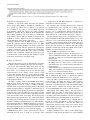
Figure 1.
A Scratch script defining the ball behaviour for a game of Pong
various scripting environments. Multiple different domainspecific grammars can be transparently loaded during a
typical authoring session. The graphical front end is backed
by a distributed infrastructure comprising both server-side
and client-side script hosting and coordinated by a wide-area
type-safe messaging platform.
Our adoption of Scratch’s tile-based programming metaphor
enables us to avoid the shortcomings of traditional programming languages whilst unlocking their power. Today, users
who are able to articulate the shortcomings of their devices’
behaviour and even outline improved behaviours in natural
language, find it impossible to author instructions which a
computer can execute. Even professional programmers are
typically able to code behaviours only for a limited subset of
deployment environments in which they have expertise. They
too face a steep learning curve to get to grips with a new set
of tools and capabilities.
Most pre-existing approaches make sacrifices as they seek to
shield the user from programming. Instead, we try to unlock
the compositional richness which programming affords, but
shield the user from unnecessary cognitive hurdles associated
with two key phases; constructing valid code to represent a behaviour, and deploying code which implements that behaviour
to the target device.
III. C ONSUMER C ONTROL PARADIGMS
Non-programmers seeking a specific digital behaviour have
few choices today.
They can explore the user manual, interactive menus and
configuration options provided as part of a product or service,
and hope that it is possible to achieve their chosen behaviour in
this way. Alternatively they can explore the market for third
party software, which may extend a system’s capabilities to
accommodate the chosen behaviour. Lastly they can attempt
to author their own behaviour through a ’mashup’.
Our project falls into the latter category, but we believe there
are important contrasts to be made with pre-existing work in
all of these categories.
In an ideal world, the creators of a device, application or
service would have anticipated all the relevant behaviours and
integrations with other devices which could possibly be desired
by their future users.
Of course in practice, there are limitations on the amount
of effort which can be invested in programming, design
and testing. However, even if we discount this limitation
there are additional, and probably more significant, limitations
imposed by the presentation layer of a manual or menu; that
technical writers and user interface designers have to employ
labelling and organisational principles which are simple and
approachable to the lay user. The more features which are
crammed into the documented capabilities of a device and
its configuration options, the less likely these features are to
ever be encountered or understood. We expand on this issue in
Section IV-A when we explore the difference in the expressive
power of a combinatorial language by comparison with the
’parameter space’ exposed to the user using traditional menu
techniques.
The expressive richness of BT Rules scripts makes the case
that system designers need not limit their systems’ capabilities
merely in order to make them comprehensible to the lowest
common denominator user, assuming the choice of interface
is correct.
B. Third Party Software Development
Although it is possible to commission a professional programmer to construct and maintain bespoke software tailored
to a single user, costs are prohibitive. Consumers seeking
an automated behaviour which is not available out-of-the-box
typically rely on an industrial software production pipeline fed
by marketing intelligence about bulk user requirements at one
end, and supported by domain specialist programmers at the
other.
If they are lucky, the pipeline will serve them well. Their
need will be identified, it will be judged to be cost-effective
or desirable to supply that market, a piece of software will
be written which is fit for purpose and they will discover the
software.
However, this strict set of criteria severely limits the likelihood of a customer encountering and acquiring digital behaviour which suits their requirements. The resource overhead
of this pipeline is very high, incorporating marketing and
usability professionals, accounting staff and programmers; and
its capacity is consequently very limited. The more specialist
their requirement, the smaller the chance of scarce resources
being made available to satisfy it.
BT Rules overcomes this resource limitation by enabling
the user themselves to resource the requirements capture,
behaviour authoring and testing. The expensive pipeline collapses into a process which can be managed by single person,
who also happens to be the end-user.
C. Mash-up and Script-hosting providers
A mash-up is an orchestration hosted by a provider who
exposes various systems to a consistent middleware and