1
4.7.3
Verification of a DSC call before transmission
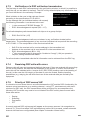
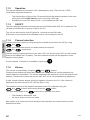
The final step in each DSC call sequence is the verification window, in which it is possible to
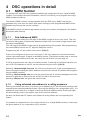
verify the call you are about to transmit. The VHF will by default display only information that
you could influence in the call setup. Example:
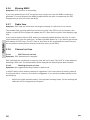
Transmit Station Call
What is hidden to the user is that calls are formed
MMSI: 001234567
according to the specifications ITU R.493-11.
Detail
For the example call (an individual station call request)
the following information is not shown to the user:
•
•
1st tele-command: F3E/G3E Simplex TP
EOS: Acknowledgement request (RQ = 117)
OK/send
<Menu/back
For all radiotelephony calls transmitted to all ships or to a group of ships:
•
EOS: End Of Call (127)
Transmitted acknowledgement calls are not shown in any verification window before
transmission. The acknowledgement of any received individual call request will be according
to ITU R.493-11. The manipulation of the received call will be:
•
•
•
•
Self-ID in the received call is used as address in the transmitted call
Address in the received call is used as self-ID in the transmitted call
EOS: Acknowledgement (BQ = 122)
1st tele-command might be changed to “Unable to Comply” (104) on operator’s
request, stating the selected reason.
For all received or transmitted calls the full information can be retrieved from the DSC log.
4.7.4
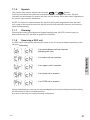
Receiving DSC calls with errors
Distress calls will have an importance that high that even if they are received with errors they
will, as far as possible, be received and displayed on the screen. If a call is received with
errors this will be indicated with a “receive error” (REC ERR) marking next to the heading of
the call. In this case the full integrity of the data is not to be trusted, and the handling
possibilities (e.g. relaying the call with direct use of the received data) are limited by the
equipment.
4.7.5
Priority of DSC versus VHF
If a situation occurs where there is a conflict between the VHF and the DSC functionality (for
instance voice transmission on a working channel – using PTT, simultaneously with transmission of a DSC call), the DSC transmission will be prioritized. As a consequence the
following VHF functions may need to be re-initiated if the DSC activity has occurred while
these were active:
•
•
•
•
Replay
Scanning
Dual watch
PTT
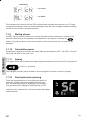
A normal received DSC call request will appear on the screen as soon it is recognized on
channel 70. This will not affect VHF radiotelephony before OK is pressed, unless automatic
channel shift has been configureded (See chapter: Automatic channel shift:)
20
0544