1
Training Information
The Thrane & Thrane RT5022/RT5020 VHF radio is designed for ‘occupational use only’ and
is also classified as such..
It must only be used in the course of employment by individuals aware of both the hazards
as well as the ways to minimize those hazards.
The radio is thus NOT intended for use in an uncontrolled environment by the general public.
The RT5022/RT5020 has been tested and complies with the FCC RF exposure limits for
“Occupational Use Only”. The radio also complies with the following guidelines and standards regarding RF energy and electromagnetic energy levels including the recommended
levels for human exposure:
•
FCC OET Bulletin 65 Supplement C, evaluating compliance with FCC guidelines for
human exposure to radio frequency electromagnetic fields.
American National Standards Institute (C95.1) IEEE standard for safety levels with respect to
human exposure to radio frequency electromagnetic fields, 3 kHz to 300 GHz.
•
American National Standards Institute (C95.3) IEEE recommended practice for the
measurement of potentially hazardous electromagnetic fields - RF and microwaves.
Below the RF exposure hazards and instructions in safe operation of the radio within the
FCC RF exposure limits established for it are described.
Warning:
Your Thrane & Thrane radio generates electromagnetic RF (radio frequency) energy when it
is transmitting. To ensure that you and those around you are not exposed to excessive
amounts of that energy (beyond FCC allowable limits for occupational use) and thusto avoid
health hazards from excessive exposure to RF energy, FCC OET Bulletin 65 establishes an
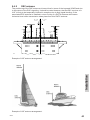
MPE radius of 10’ (3m) for the maximum power of your radio (25W selected) with an antenna
having a maximum power gain of 9dBi. This means that all persons must be at least 10’ (3m)
away from the antenna when the radio is transmitting.
Installation:
1.
An omni-directional antenna with a maximum power gain of 9dBi must be mounted at
least 16.4’ (5m) above the highest deck where people may be staying during radio transmissions. The distance is to be measured vertically from the lowest point of the antenna. This
provides the minimum separation distance which is in compliance with RF exposure
requirements and is based on the MPE radius of 10’ (3m) plus the 6.6’ (2m) height of an
adult.
2.
On vessels that cannot fulfil requirements in item 1 , the antenna must be mounted
so that it’s lowest point is at least 3,3’ (1m) vertically above the heads of people on deck and
all persons must be outside the 10’ (3m) MPE radius during radio transmissions.
•
•
•
Always mount the antenna at least 10’ (3m) away from possible human access
Never touch the antenna when transmitting
Use only authorized T&T accessories.
Failure to observe any of these warnings may cause you to exceed FCC RF exposure limits
or create other dangerous conditions.
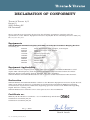
0544
iii