1
ESPaDOnS: thermal response and spectral stability
http://webast.ast.obs-mip.fr/magnetisme/espadons_new/stability.html
ESPaDOnS
Thermal response and spectral stability
General concept
To ensure that ESPaDOnS would be as stable as possible, we decided to follow the advice of the Geneva experts for improving
the stability of echelle spectrographs. Without going to the extremes of enclosing the entire spectrograph within a depressurised
and thermally regulated container (eg as was done for harps, the eso spectrograph dedicated to ultra high precision
measurements of stellar radial velocities and mounted on the la silla 3.6m telescope), we converged towards an intermediate
solution involving a double-layer thermal insulation. The concept (recommended by the Geneva experts) features:
an inner thermally-passive enclosure in which the spectrograph table (and optical and mechanical components
mounted on it) are included;
an outer thermally-active enclosure containing the inner enclosure and in which the temperature is regulated at an
accuracy of about 0.1deg.
This ensures in particular that the temperature within the spectrograph is stable to a rms level of a few 0.01deg, provided that
operations within the inner enclosure are kept to an absolute minimum. For both scheduling and practical reasons, it was
decided that only the inner enclosure is built while ESPaDOnS is at OMP, while the outer enclosure and thermal regulation is
implemented in a second step, once ESPaDOnS is installed in the coude room of cfht.
Accurate temperature sensors (with a precision of 0.01deg) are implemented at different points within the inner enclosure to
check the stability and estimate potential temperature drifts and gradients. A digital barometer is also implemented within the
inner enclosure to monitor pressure fluctuations at the 0.01mbar level. To minimise operations within the inner enclosure, the
ccd filling and exhaust pipes are installed permanently and are thermally insulated (within an evacuated tube) from the inner
spectrograph environment.
Performance of inner enclosure
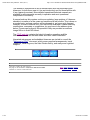
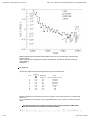
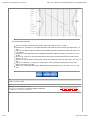
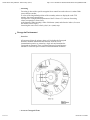
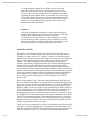
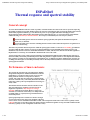
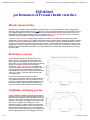
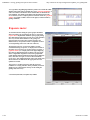
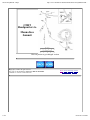
The graph on the right shows the room temperature (full line)
along with the temperature within ESPaDOnS inner enclosure
(dashed line), as recorded in a long test run of several weeks
during which the enclosure was kept closed as much as
possible. This graph shows the temperature variations during
about four consecutive days, where daily fluctuations in outside
temperature (with a peak-to-peak amplitude of about 1deg) are
clearly visible.
This demonstrates that the inner enclosure smoothes out all
short term temperature variations by at least an order of
magnitude. In particular, daily changes are no longer
detectable within the spectrograph. However, longer term
variations (on a timescale of several days) are still present and
essentially mimic (as expected) the long term fluctuations in
outside temperature.
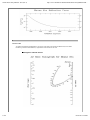
Spectrograph temperature variations of as much as 0.7deg/d
are observed in the present context; they should be reduced by
at least a factor of 2 once ESPaDOnS is installed at CFHT, where temperature drifts in the coude room are typically of order
0.1degr/d and rarely exceed 0.3deg/d. Once the outside enclosure and thermal regulation is setup, such drifts should be further
reduced by typically an order of magnitude on timescales of days.
1 of 2
08/07/04 11:30 PM