1
Chapter 7. Commercial Deployment
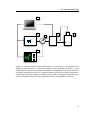
To fulfill the sensing requirements we decided to design our own sensor board. The sensor
board is composed of an analog 3D accelerometer, a high-precision 16-bit ADC, 2 MiB of
non-volatile, high-speed, low-power RAM, a low-power accurate real-time clock, an efficient
power management system and a low-power FPGA.
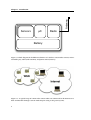
A sensor node consists of an Iris radio board, our sensor board, a high-capacity battery, an
external antenna, and a rain-water-tight packaging. A relay node consists of an Iris radio board,
a high-capacity battery, an external antenna, and a rain-water-tight packaging. The gateway
node consists of an Iris radio board, a USB interface board, a GPS receiver optimized for time
synchronization, and external antennas for GPS and WSN communication. The gateway node
is directly connected to the back-end computer via USB, which also provides the power.
7.5 Protocol Stack
Normally, the philosophy behind wireless sensor networks is to have algorithms and protocols that are completely distributed and decentralized. Because of the large bandwidth
requirements on the one hand, and the limited energy budget on the other hand, existing
distributed solutions were inadequate, as they either used too much energy, or would not
allow to transmit data fast enough. The time and resource budget of the project was too small
to design, debug and thoroughly test new distributed algorithms. We therefore also looked
at centralized algorithms as an alternative. Since the purpose of the network can only be
fulfilled if data from nodes can reach the back-end, a centralized control does not limit the
functionality of the network. As the development of centralized algorithms is much easier,
and we could reuse our existing code, which was already designed as a centralized algorithm
to better control the experiments (see Section 4.4), we finally decided to adopt a centralized
network control mechanism.
From the preliminary field test we know that the radio environment is fairly stable. We
therefore decided to design the network to operate in two modes: management mode and
regular operation mode. In the management mode, all network management tasks, such as
network discovery and node configuration, are performed. Once the network is configured,
we expect the radio environment to be stable for long periods of time (hours to days). The
network is thus switched to the regular operation mode, where only data is transmitted at a
fixed schedule and no route maintenance is performed. The management mode does not
minimize energy consumption, as it is expected to be used only for short intervals of time. The
regular operation mode is expected to be active during most of the life time of the network, and
hence we focused our energy consumption minimization efforts in this mode of operation.
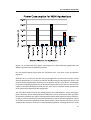
To minimize energy consumption, any unnecessary activation of the radio should be avoided.
We have seen in our experiments described in Section 6.2.1 that in a CSMA-based network
most of the energy used to transmit a message is spent during the random back-off time,
when the radio listens whether the channel is free. If each node knew exactly when it can
have exclusive access to the channel, it would not need this contention phase. We decided to
102