1
Free Working Environments for Computer Algebra
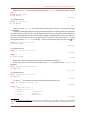
(%i4) counter
(%o4) 25
17 msec
Obviously, when Maxima is called directly by TeXmacs, and not through Sage, the for loop is
executed without any problems and we obtain the correct answer.
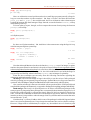
Next we initiate a session with Pari. Again, the factorization is easily done:
Pari] factor(x^2-9)
x − 3 1
x + 3 1
%1 =
and so is the for loop to count the prime numbers ≤ 100:
Pari] counter = 0
%2 = 0
Pari] for(i=1,100,
if( isprime(i), counter = counter + 1 )
)
Pari] counter
%3 = 25
80 msec
12 msec
54 msec
11 msec
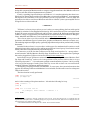
Out of curiosity, we initiate a session with Sage and, through it, we call Pari/Gp to perform the
same for loop and compare times:
Sage] counter = pari(0)
73 msec
Sage] for i in range(100):
if pari(i+1).isprime():
counter = counter + 1
356 msec
Sage] counter
25
74 msec
Clearly, Sages interface slows things down quite a bit.
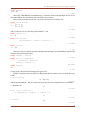
Finally, we initiate a session with Giac. Here again the factorization is as was in the previous
CASs:
> factor(x^2-9)
(x 3)(x + 3)
92 msec
and the prime numbers ≤ 100 are counted in about the same way using the function isprime():
> counter:=0
0
> for (j:=1;j<=100;j++) {
if (isprime(j)) {counter := counter + 1}
}
0
> counter
ÈÍÔÎÐÌÀÖÈÎÍÍÛÅ ÑÈÑÒÅÌÛ
25
58 msec
83 msec
83 msec
41