1
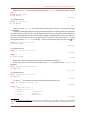
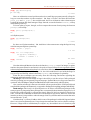
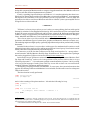
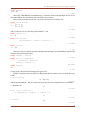
Alkiviadis G. Akritas Xcas/Giac also known as the «Swiss knife for Mathematics» is a powerful CAS (combined with programming, interactive 2-d and 3-d geometry and a spreadsheet) that is under active development by Bernard Parisse and supported by a worldwide community of contributors. Besides its ability to link to TeXmacs, Xcas/Giac can also link to the computer algebra systems CoCoA and Pari as well as to several other free, open source libraries, utilizing all the efficient and fast routines that are available.1 Giac is linked with Pari through the command pari(), which makes available to Giac all the functions of the Pari library provided they are prefixed by pari . So we can have: > pari() 55 msec > pari_factor(x^2-9) x − 3 1 x + 3 1 85 msec From the above examples we can easily draw the following conclusions regarding the advantages and disadvantages of TeXmacs: Advantages: A first advantage of TeXmacs is that it offers a wider choice of CASs to use than Sage; namely, it offers most of the packages that come bundled in Sage, Sage itself plus additional ones listed in http://www.texmacs.org that are not bundled in Sage. The fact that these CASs have to be installed separately is not a problem at all for package distribution systems like Debian/ Ubuntu. Secondly, the interface of TeXmacs with each individual CAS is direct and not prone to problems that arise using Sages interface as for example Sages interface with Maxima that we saw in the previous section. Finally, if the user already has experience with a certain CAS, then s/he can go on and use it right away with TeXmacs as an interface, without having to worry about learning Python first. Disadvantages: The only disadvantage that one might attribute to TeXmacs is the fact that one cannot use it as an editor for the Greek language; however, Greek letters are available in math mode. Hopefully, this situation will be remedied in the future. 4. CONCLUSIONS From the previous discussion it is obvious that for the packages discussed in this paper we have the following «dependencies»: Therefore, if your favorite CAS has a TeXmacs plug-in and you need a powerful editor, then TeXmacs is the interface to use. It is worth noting that after TeXmacs session with the corresponding CAS has been initiated, along with the system information there appear instructions on how to 1 That 42 is, unlike Sage, Giac glues the C libraries at the C level. © ÊÎÌÏÜÞÒÅÐÍÛÅ ÈÍÑÒÐÓÌÅÍÒÛ Â ÎÁÐÀÇÎÂÀÍÈÈ. ¹ 6, 2012 ã.