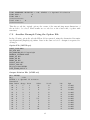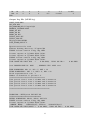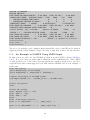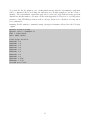
1
3
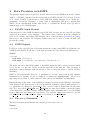
Data Provision in SMPS
3.1
SMPS Input Format
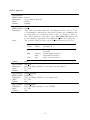
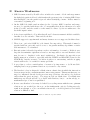
Whereas MPSX defines the format for LP data input, Stochastic MPS (SMPS) defines the
input format for stochastic programming problems. FortSP implements the most important
provisions of SMPS which is described by Birge et al. (1987). Since the solver is initially
designed for use within the SPInE system its stochastic input fulfils the requirements of
models generated by SPInE, and other provisions of SMPS are not supported in full. SPInE
generates solver stochastic data in the form of discrete scenarios, and FortSP supports this
form and also discrete blocks form and discrete independent form.
The stochastic items time-stage, block and scenario are all to be identified by an index with
optional prefix for readability, although SMPS standard calls for identification by the full
name (prefix plus index). FortSP ignores every prefix, but nevertheless user should adopt
the same prefix for the same item throughout, in conformity with the SMPS standard. A
future version of FortSP may be upgraded to identify by name rather than by index.
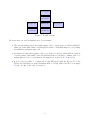
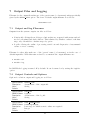
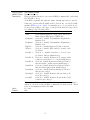
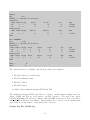
Three input files are required in order to specify a stochastic problem:
• Core file which is the fundamental problem template in the form of an LP problem
using the MPSX standard
• Time file specifying which rows and columns of the core-file belong to which time stage
• Stoch file specifying the alternative values taken by each random parameter value in
the core file
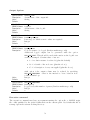
The user may specify precise names for the input files or may give the basename - or ’Generic’
name - of these files so that extensions are appended automatically. Denoting a base name
by <problem> the resulting filenames are:
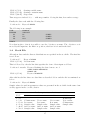
<problem>.cor for core file
<problem>.tim for time file
<problem>.sto for stoch file
3.2
Core File and Random Parameter Values
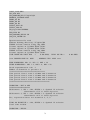
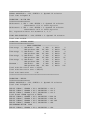
The core file expresses a linear programming problem or linear mixed integer problem in the
format known as MPSX, familiar to the users of LP solvers and described in the manuals
of many of such system, for example, FortMP (Ellison et al., 2008). In this format the file
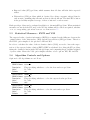
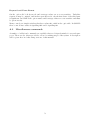
is divided into ROWS, COLUMNS, RHS, RANGES and BOUNDS sections, and data records have a
fixed format as follows:
Field
Field
Field
Field
Field
Field
1.
2.
3.
4.
5.
6.
Positions
Positions
Positions
Positions
Positions
Positions
2-3 (code)
5-12 (1st name field)
15-26 (2nd name field)
30-37 (1st numeric field)
40-47 (3rd name field)
50-61 (2nd numeric field)
15