1
HP-IB
HP-IB
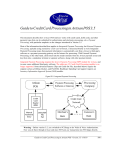
Request: Wait until Time = 30 Seconds, then
Turn on Digital Output Slot 3, Channel
12. Wait for Trigger from Input at Slot 2,
Channel 1; then Take Analog Input
Measurements from Slot 1, Channels 1
through 4 and Read the Time Elapsed.
Result: Condition Code = 0 (No Errors),
Channel 1 = 100 mV, Channel 2 =
200 mV, Channel 3 = 300 mV,
Channel 4 = 400 mV, Time = 50
Seconds, 26 Milliseconds.
Fig. 5. Message flow among the
three 2240A firmware tasks.
sequences will not preclude using the 2240A with a
given controller. HP has begun describing the use and
the capabilities of its computers and instruments in
terms of messages transferred. This provides a com
mon ground for relating any instrument to any com
puter. The objective is to allow the use of N instru
ments with M computers without writing N times M
user's manuals. The 2240A uses the following HP-IB
messages: data, clear, require service, status bit, and
abort.
Computable Parameters. Careful consideration to
parameter format assures straightforward program
ming. Consider the request: AB,3,4,i,-ioo!. This analog
bipolar output command will cause -100 millivolts
to be produced at the connection to channel 4 of the
digital-to-analog converter in slot 3. This seems sim
ple enough, but more often than not some or all
parameters are computed and come from program
variables instead of ASCII constants. This usually
results in a character sequence such as:
and trailing blanks. Spaces, commas, and semicolons
may be freely used as delimiters, and upper or lower
case letters are acceptable for commands. While de
limiters make a request more readable, they are re
quired only between adjacent numeric fields.
Explicit Request Terminators. The exclamation point
(!) was chosen as the request terminator to avoid a
programming complication. While most computers
send the ASCII carriage return and line feed (cr If)
characters at the end of a message, suggesting their
use as a message terminator, some do not. Still others
send cr If in the middle of messages, after every few
numeric fields. The2240A ignores cr If sequences and
continues to accept request characters until ! is re
ceived. This convention frees the programmer from
concern with the cr If conventions of the computer. It
is particularly convenient to know that cr If is ignored
when multiple write statements are used to send ar
rays of data within a request.
Universal Result Format. The result carries mea
surement, timing and error information to the com
puter. All 2240A quantities are expressed as integers
and transmitted in standard free-field ASCII for
mat. This format is acceptable to all current HP com
puters that support the HP-IB. The 2240A will pad
the result with zeros and commas to the extent re
quired to satisfy a read statement that asks for too
much data. This normally occurs after an error termi
nates a request but the program expects measure
ments in the result. Padding avoids a potential
"hang-up" situation.
Respect for Buffer Size. While the 2240A can produce
a result nearly 1600 characters long, some languages
restrict the number of characters that may be trans
ferred by a single read statement. This limitation
AB, 3 3.99999 1, -100.37 !
This has exactly the same effect as the previous re
quest. The 2240A rounds the 3.99999 to 4, the
-100.37 to -100, and is tolerant of the extra delimit
ers. Difficult-to-compute formats, such as 100— for
negative voltages and 3.4 for slot 3 channel 4, have
been avoided.
Flexible Request Syntax. Some peripherals require
that the programmer precisely control the data format
of a WRITE or other output statement. The 2240A re
lieves the programmer of these concerns by accepting
anything that a person can read unambiguously.
Commands and data may be surrounded by leading
15
© Copr. 1949-1998 Hewlett-Packard Co.