1
DISPLAY [{ A | C | G | I | L | M | T }]
Immediate
This command (when entered alone) causes the TALON to display a list of all the current
parameter settings in the TALON. A subset of this list will be displayed by specifying a
class identifier for a group of command parameters. When using the DISPLAY command
with a subclass, be sure to use a space between the DISPLAY command and the subclass.
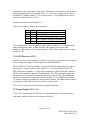
Subclasses of related parameters are:
$6<1&
&+$5
*36
,'
/,1.
021,725
7,0,1*
DV\QFKURQRXVSRUWSDUDPHWHUV7$/21WRFRPSXWHU
VSHFLDO7$/21FKDUDFWHUV
SDUDPHWHUVUHODWHGWR*36RSHUDWLRQV
,'SDUDPHWHUV
SDUDPHWHUVDIIHFWLQJSDFNHWOLQN7$/21WR7$/21
PRQLWRUSDUDPHWHUV
WLPLQJSDUDPHWHUV
Individual parameter values can be displayed by entering DISPLAY and the command
name, followed by “CR”.
See also: Display Listings section
DWAIT n
(n = 0 - 255)
default 0
DWAIT defines a delay to be used to avoid collisions with digipeated packets. The value
entered for “n” is the number of 10 ms intervals, after last hearing data on the channel,
for the TALON to wait before it begins its own key-up sequence.
This value should be established and set equally in all members of a local area network.
The best value will be determined by experimentation but will be a function of the key-up
time (TXDELAY). This feature is made available to help alleviate the drastic reduction
of throughput, which occurs on a channel when digipeated packets suffer collisions.
Digipeated packets are not retried by the digipeater but must be restarted by the
originating station. If all stations specify DWAIT, and the right value is chosen, the
digipeater will capture the frequency every time it has data to send since digipeated
packets are sent without this delay.
Observations have proven that a better algorithm for avoiding collisions between enduser stations, while still allowing digipeaters the high-priority access they require is
Page 69 of 101
DWG ID: 181-0101-00A
Date: 2003-09-26