1
are generated only when you want them to. It should be shortly flashing whenever
any key on entire system is pressed or released, and while the potentiometers are
rotated. This indicator is not intended to be wired to the panel by soldering wires to
it. It's only there for troubleshooting aid during installation.
Expanders
MIDI128 controller board works only with 2 keyboards, but it can be expanded by 2
additional controllers. Depending on their size, the whole system can cover up to 6
keyboards or 384 keys over single MIDI socket. Currently there are 3 sizes
available: 32, 64 and 128 keys, the last one is also a dual diode matrix scanner and
has the 128 keys split into 2 keyboards. Type of the scanner needed is determined
by keyboard size and the way how switches are organized. Connection between
keyboard scanner and MIDI128 mainboard is always the same, regardless of the
type of scanner. MIDI settings of those keyboards can be changed by the user after
all connections are in place.
32-keys expander - PEDSCAN-X
Pedal board controller takes care of 32 keys. It's very
small board that can be fitted inside pedal board, and it
connects to the main board via supplied 4-wire cable
from J2 connector.
Switches must be organized in 4x8 diode matrix. Details
are shown in schematic below. numbers 1-12 at the right side of the schematic
must match the numbers on the PEDSCAN-X board diagram.
The groups of 8 switches with 1 common lead must be separate. In case
of keyboard with 1 common bus bar going through entire keyboard, you
have to cut the bar every 8th key.
128-keys expander - DMS-2K
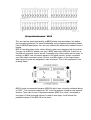
For increased number of keys, you may use DMS-2K, adding another 128 inputs.
Layout is shown on next page. There are two 16-way connectors, that usually are
used to connect diode-matrixed keyboards. Smaller connector marked is used to