1
Technical Newsletter
WINTER 2005
Technical Session
This Technical Session introduces a suite of new
tire-terrain models that greatly extend the capabilities
for HVE vehicle simulation. The new tire-terrain models
are:
Ø Radial Spring Model
Ø Sidewall Impact Model
Ø Soft Soil Model
Each of these models can be selected to replace the
(default) Point Contact Model and provides a specific
capability not previously available.
Point Contact Model
To better understand how the new models provide
additional modeling capabilities, it is useful to
understand something about the Point Contact Model.
As its name suggests, the Point Contact Model
assumes that the tire force, Fx’, Fy’, is a shear force
applied at the ground plane at a single point directly
beneath the wheel center. This assumption is good for
a majority of conditions. In particular, the default model
assumes a flat (not necessarily horizontal), rigid terrain.
Radial Spring Model
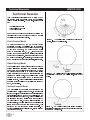
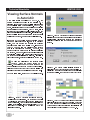
The Radial Spring Model models the tire as a series of
springs lying in the tire plane and projecting radially
outward from the wheel center (see Figure 1). Whereas
the Point Contact Model may be thought of as a single
spring projecting downward and interacting with the
terrain at a single point, the Radial Spring Model
provides numerous springs that may interact with
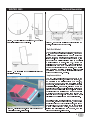
multiple surfaces. This model is ideal for simulating tires
mounting curbs and rolling over potholes (see Figures 2
and 3, respectively).
Sidewall Impact Model
The Sidewall Impact Model is an extension of the
Radial Spring Model, described above. In the Sidewall
Impact Model, each radial spring has additional springs
projecting laterally outward from the wheel plane to the
tire sidewall plane (see Figure 4 ). This model allows for
the first time a rigorous modeling of the force applied to
the sidewall of a tire. Because it is not limited by
coulomb friction, the sidewall force may be significantly
larger than the force at the tire contact patch. This
provides a new and important modeling capability. An
obvious application is the classic curb-tripped rollover
(see Figures 5 and 6).
2
Figure 1 - The Radial Spring Model uses evenly spaced
springs, instead of a single spring.
Figure 2 - The Radial Spring Model is useful for simulating
conditions in which there are multiple tire-terrain contact
points.
Figure 3 - The Radial Spring Model is also useful for
simulating conditions in which the contact point is not directly
beneath the wheel center.