1
Operating Instructions
Diver-NETZ
CE COMPLIANCE STATEMENT (EUROPE)
This device is in conformity with the EMC directive and low-voltage directive.
1. Introduction
With Diver-NETZ technology, monitoring ground and surface water becomes easier, faster and more reliable.
Diver-NETZ is a wireless method for reading out Diver data, Baro data and programming Divers. A physical
connection between read-out equipment and Diver is no longer necessary.
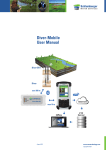
With Diver-NETZ it is no longer necessary to find the monitoring well, the monitoring well finds you. The
monitoring well (with Diver-DXT installed) periodically tries to connect to an available Diver-Gate(M) in radio
range. This Diver-Gate(M) is connected to the field computer (smart-phone or PDA) using Bluetooth. As soon as
you have read out the field data with the field computer, you can transfer the data to a FTP server or keep it in
the local queue. All data will be stored in the database of the field computer. Programs like Diver-Office and
Diver-Office Premium are used to interpret, validate or visualize the Diver-data.
Any existing network of Divers can be fitted with the Diver-NETZ technology quickly and easily.
1.2 Functional description
The Diver-DXT allows for a wireless remote access to the data stored in the Diver. The enclosure which
contains the radio PCB and battery remains on ground surface, the Diver is placed below ground level inside a
well. Both units are connected using a two-wire cable, which acts both as a communication link and as a
mechanical link to place the Diver into the well at a known distance.
The Diver is placed into a well, connected by a cable to the Diver-DXT (radio) which remains on the surface
(well cover) or just below the surface (street pot). Once configured, the Diver will autonomously collect and
store
temperature and pressure data into its non-volatile memory at a certain sampling rate (customer setting). The
Diver is equipped with its own power supply (battery). The Diver has an optical interface and therefore there is
no electrical connection to the rest of the system (Diver-DXT and cable).
Once the operator wants to retrieve data from the Diver (or any other communication like configuration of
sampling rate or other settings), a radio link between a second radio (Diver-Gate(M)) and the Diver-DXT can be
established in a “drive-by” or “walk-by” manner.
The radio link between Diver-Gate(M) is realized according to the IEEE standard 802.15.4:
Wake-up Session
When the Diver-Gate(M) communicates with the Diver-DXT, it first starts with a wake-up session to awake all
the Diver-DXTs around and get a list of them. It sends broadcast wake-up frames permanently (each 7ms)
during 29s. Within these frames a countdown is included related to the remaining wake-up session duration. In
Van Walt Ltd | Prestwick Lane | Grayswood | Haslemere | Surrey | GU27 2DU | Tel. 01428 661 660 | Fax. 01428 656 808 | www.vanwalt.com