1
4.2.5 Conclusion of structural fault analysis
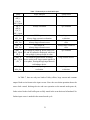
From the analysis above, it is known that the first and third part require the
dynamic patterns of weakest one input and weakest zero input as the minimum vector set,
while the second part demands all weak inputs. And the fourth part is the responsibility of
the scan chain test beforehand.
To conclude, it is approved that the general test vectors for all the three types of
structural faults are all weak inputs by means of dynamic patterns. Sequence of them does
not matter. Same scheme also works for other function in other cells, from TLL3_21 to
TLL9_54.
Depending on the feeder and the signal assignment to the TLL, undetectable faults
sometimes exist in the input and threshold networks. It is also possible in the practice that
some input vectors in the truth table of the TLL function can never be activated through
the feeder and signal assignment. If, for example, the weakest input does not exist, the
secondary weakest input takes its place. This is also the reason of representing all weak
inputs as dynamic patterns rather than merely the pair of weakest inputs. Moreover, if no
weak input is available, strong inputs kick in, which lead to untested faults such as the
stuck-open faults on discharge devices. Coverage of faults changed by the absence of
some vectors can be checked from the complete test set for each fault in the column of
fault result.
52





























![[Unlocked] SC-2042](http://vs1.manualzilla.com/store/data/005660029_1-1367986a5e7a7fe673239a9957384234-150x150.png)