1
2.2.1 Formal Specication Languages
Formal specication language are designed for formality, but not for execution. Consequently
they include constructs, such as universal quantication, which are precisely dened but are
not constructive. In other words there are constructs which cannot be mapped onto any
(practical) algorithm.
Luckily the class of problems for which ECLi PSe is designed have a nite set of decision
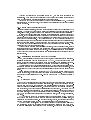
variables each of which admits only nitely many alternatives. Consequently it is only necessary to support a restricted form of logic2 which is easier to understand and easier to
implement. The nearest thing ECLi PSe oers to universal quantication is iteration over
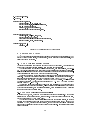
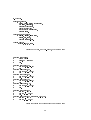
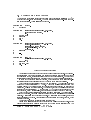
nite sets, as for example the goal applist(value,Countries) in gure 1.
The restricted logic of ECLi PSe has a benet that the mapping from the conceptual model
of the problem to the design model is an extension of the conceptual model rather than a
rewriting. This means that when problem requirements change it is natural to capture this
change in the conceptual model, and then carry them through to the design model. The result
is that during application development the conceptual model and the design model remain in
step. This avoids many of the pitfalls which await developers working on applications whose
specications are changing even during application development!
2.2.2 Mathematical Modelling Languages
There already exists a class of modelling languages designed for combinatorial problems.
These are the mathematical modelling languages typically used as input to mixed integer
programming (MIP) packages. We further discuss MIP, and how to use it through ECLi PSe
, in section 3.4 below.
Although the syntax is dierent, mathematical modelling languages share many of the
features of logic programming. They support logical variables, and constraints. They support
numerical constraints which, though not supported in traditional logic programs, are supported
by constraint logic programs as we shall see in the following section. They support named
constraints, which is achieved in constraint logic programming by introducing a predicate
name, eg precede(T1,T2) :- T1 >= T2.
There are two facilities in constraint logic programming which are not available in mathematical modelling languages. The main one is quite simple: in constraint logic programs it
is possible to dene a constraint which involves a disjunction. Mathematical programming
cannot handle disjunction directly. The second dierence is that logic programming allows
new constraints to be dened in terms of existing ones, even recursively. In mathematical programming the model is essentially at, which not only complicates the model but also reduces
reuseability within an application and across applications.
To illustrate the advantage of handling disjunction in the modelling language, we take a
toy example and present two models: a mathematical programming model and a constraint
logic programming model.
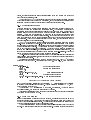
Consider the constraint that two tasks sharing a single resource cannot be done at the
same time. The constraint involves six variables: the start times S1 ; S2 , end times E1 ; E2 and
resources R1 ; R2 of the two tasks. The specication of this constraint is as follows:
either the two tasks use distinct resource ( R1 ne R2 ) or task1 ends before
task2 starts (E1 S2 ) or else task2 ends before task1 starts (E2 S1 ).
First we shall show how it can expressed as a mathematical model without disjunctions. For
this purpose it must be encoded using numerical equations and inequalities, together with
integer constraints.
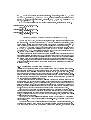
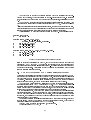
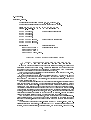
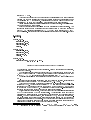
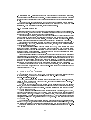
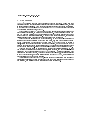
The disjunctions can be captured by introducing three 0/1 variables, Br1 , Br2 , and Bt ,
and using some large constant, say 100000, larger than any possible values for any of the six
variables. Now we can express the constraint in terms of numerical inequalities as follows:
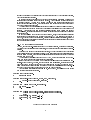
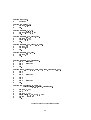
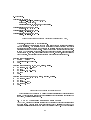
R1 + 100000 Br1 + 100000 Br2 R2 + 1
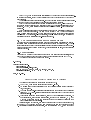
R2 + 100000 Br1 + 100000 (1 Br2 ) R1 + 1
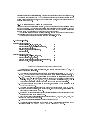
S1 + 100000 (1 Br1 ) + 100000 Bt E2
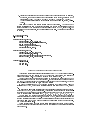
S2 + 100000 (1 Br1 ) + 100000 (1 Bt ) E1
2
technically called Horn clauses
4