1
1.3 CTRNet
The NSF-funded CTRnet project archives disaster-related online data such as Twitter messages (i.e., tweets)
as well as web sites in collaboration with the Internet Archive (IA). In addition to about 45 web archives,
more than 114 tweet archives have been created. Tweets from both natural (e.g., hurricanes, earthquakes,
floods, Tsunami, etc.) and man-made disasters (e.g., school shootings, plane crashes, political turmoil, etc.)
are captured using a tool that accesses both search and streaming APIs provided by Twitter. The tool
retrieves tweets based on hashtags and keywords, which are configured in advance, then stores them into a
local database for research purposes.
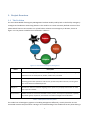
1.4 Project Management
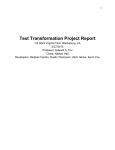
This project was completed as a part of CS5604: Information Storage and Retrieval, a graduate Computer
Science course at Virginia Tech during the Fall Semester, 2012. The work was conducted for the CTRNet
project, under the supervision of Seungwon Yang. In addition, we were assisted by Sunshin Lee and Haeyong
Chung, who provided tweet processing and visualization/infoVis support, respectively.
Over the course of the semester, we held weekly meetings with the client to discuss our progress, refine the
research direction, and to assign units of work. In general, Xiao was responsible for the tweet processing, to
include pre-processing and machine learning approaches. Liangzhe was primarily responsible for the
visualization component. Andrew provided support in both categories, beginning in natural language
processing and entity extraction, and eventually aiding in visualization and evaluation. All group members
contributed to discussions in each area during group meetings.
1.5 Challenges and Future Work
As the project evolved over the course of the semester, we ran into a number of challenges. As we already
had the data on hand, the first challenge was what machine learning approach to take to categorize the
tweets into a phase. We first began with clustering, but ultimately settled on a classification approach.
Another challenge was how to extract meaningful information from data which was by definition extremely
short. Much of the data is irrelevant to our purposes, or personal in nature. For the purposes of this project,
we decided to manually extract certain professional organizations and classify only those tweets, also
manually, to create the classification training data set.
In the future, the project should use a larger subset of the tweets and tackle the issue of automated entity
(professional organization) extraction. Additionally, the many tweets which are of a personal nature should
also be examined, as they do contain a great deal of data which could contribute to situational awareness
and increase the richness of the dataset. Finally, the approach needs to be extended to other datasets,
starting with similar disasters like Hurricane Sandy, and moving on to different disaster types.
4