1
USER’S MANUAL
3.2.3
Defaulting
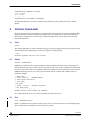
To ease the use of the language in an interactive mode, a general policy of defaulting has been adopted. Typical
command statements will have a set of position sensitive parameters with the most frequently used parameters
appearing first. The user can then specify only these parameter values which are explicity required and omit
others where upon they will default to “sensible” values defined by the creator of the command. In particular, well
written command statements will often default to the most general mode of usage or accept a default value that
has been explicitly set by a previous statement.
3.3
Constants, Variables and Expressions
The implementation of full programming language features has been side stepped in the Testtool command
language, but there still exist a powerfull underlying mechanism for mathematical manipulation and expression
handling.
3.3.1
Numbers
The Testtool supports the use and manipulation of integer and floating point numbers. The number range of
integers is limited by the supporting machine’s natural 32 bit representation (in addition the value of the
maximum negative integer in this representation is used internally to signifiy an error). For more precision in
calculation, floating point types can be used. Constants and variables of both types can be declared used freely.
Integrated usage is by far the most common in practice, and integers be used at any point where a value is
required in the language.
Integer constants can be expressed in hexadecimal, decimal, octal or binary notation. At any given time, a default
base for conversion of integrer numbers is in force. The default base conversion can be overriden by explicitly
prefixing the number with a symbol that indicates the intended base of the constant value. A floating point value
is signified by including a decimal point in the notation and can be given with no decimal places, or any number
of digits after the decimal point. There are no base conversion issues with floating point numbers.
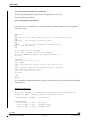
40 - INTEGER
h4F - HEX INTEGER
o67 - OCTAL INTEGER
b010 - BINARY INTEGER
+2 - DECIMAL INTEGER
-435 - DECIMAL INTEGER
4.0 - FLOATING POINT
0.2 - FLOATING POINT
3.2E5 - FLOATING POINT
To keep compatibility with previous releases, the following conventions remains available :
#4F - HEX INTEGER
$10 - BINARY INTEGER
The expression b10+o10+10+h10 is equivalent to 2+8+10+16.
3.3.2
Numeric Expressions
In place of any explicit constant value, a mathematical expression of arbitrary complexity can be used. The
expression must not contain embedded spaces, since these might be interpreted as value terminators, but may
include brackets to make precedence clear. Precedence will be exercised from right to left in normal evaluation.
The available mathematical operators are:
• + integer and floating point addition
• - integer and floating point subtraction
TST 3/24
03 November 2006
STMicroelectronics Confidential