1
Hot Climate Operation and Derating continued
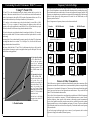
Improve Air Flow
Although locomotives and cars have many openings for air to enter, the addition of more
vents on the bottom and in the roof will greatly aid heat removal. For diesels, consider
opening up the grid and radiator fan housings especially if they are simply cast on. Drill
additional holes in the floor. Also consider removing plastic windows, especially if the
locomotive is small and the decoder is in the cab. Small muffin fans, running on 12V will
help considerably providing there is room for them. Be sure and use low current fans, to
minimize the battery drain.
Lower The Battery Voltage
Since the power dissipated by the decoder is based on the motor current and battery
voltage, a lower voltage battery will significantly lower the maximum heat generated.
You’ll also find that the batteries last longer. Yes, the top speed will also decrease but not
by much. On hilly layouts, the use of multiple locomotives in a consist is much more
efficient than a single locomotive, running at maximum power, straining to make it up the
grade.
Derating Maximum Output Current In Hot Climates
High outdoor temperatures will result in hot interior temperatures even when there is good
airflow. The G2 output current is limited to a rather high value based on the temperature of
the drivers. If the drivers overheat, through excess motor current or because of a hot
interior, the devices will shut down to protect themselves.
A good rule of thumb is to derate the available current by about 1 Amp per 10 degrees of
temperature increase above 80 degrees. For example, if the outdoor temperature is 100
degrees, the maximum allowable current should be decreased by about 2-3 Amps. The
motor drive current should not exceed about 8 Amps under any conditions.
G2 Decoder Thermal Fault Clearing
Should the thermal overload protection trip on the motor drivers, turn off the power and
allow the drivers to cool. Once cool, the power can be turned on and operation resumed.
If the thermal protection trips on the DCC Auxiliary drivers, the buzzer will sound.
Resetting is automatic and does not require the power to be turned off. However, you
should improve the air flow since this is the decoder’s way of saying that it is too hot.
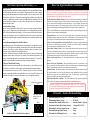
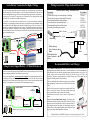
Chassis floor construction
Fair
Open grid fan grills
Don’t depend on small
openings to provide
ventilation
Better
Airflow In Modern Plastic Diesel Locomotives
34
Drill vent holes in floor
Before You Begin: Installation Considerations
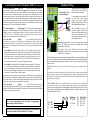
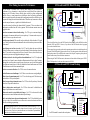
Do Not Use The Locomotive’s Internal Circuit Boards - Do not attempt to use any of the loco’s
built-in circuit boards for wiring and connections especially to the motor. This is one of the most
common causes of decoder damage and or failure of the constant speed feature. Remove the boards
and install the motor wiring exactly as shown in this manual.
Battery Chemistry and Battery Selection - The more exotic the battery chemistry, the lighter and
smaller it will be compared to a gel-cel battery having the same energy capacity. However, unlike a
gel-cel, the new battery technologies are much more sensitive to poor charging. The battery will
also be much more expensive. The matching charger will also be more expensive. However, when
properly used and charged with an appropriated charger, the batteries will have a long lifetime.
The Li-ion and NiMH batteries can be purchased from an on-line store specializing in RC cars and
airplanes. Be sure to obtain the matching charger.
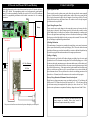
Fusing The Battery - always use a fuse in series with the battery. Large batteries can supply an
astonishing amount of energy into a short circuit. If small diameter wire is used and a short circuit
occurs, the wire will instantly become a heater element and melt the insulation from the wire.
Always Use a Power Switch Between Loco and The G2 - The use of a power switch will insure that
the battery is not discharged by the decoders. A second power switch is highly recommended
between any other decoders and the auxiliary DCC outputs.
Lower Battery Voltage Is Better - Lower voltages mean the motors and electronics run cooler.
There is also a remarkable increase in effective reception range since lower motor voltage results in
less electrical noise. For hilly railroads, consider the use of multiple locomotives on a train. Not only
will the batteries have a longer life, but the G2 decoder will run much cooler.
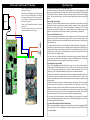
Motors Are Electrically Noisy - Use the included shielded wire to connect the decoder to the
motor(s).
Beware of Excessive Heat Buildup - The decoder should be placed in a location where it can
receive some airflow for the large transistors. These will become warm to very hot depending on the
battery voltage and motor current. Never cover the transistors or the board.
Antenna Location - The antenna should be vertical and can be bent such that it remains vertical if
the board is mounted on its side. Keep the antenna away from anything metal. Also, the antenna
should be kept away from motors and the battery wiring. For longer range, an optional longer
antenna is available. See the back page for ordering details.
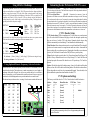
Old AirWire Motor Filter Capacitors - The 10 ohm resistor and 0.1uF capacitor supplied with
CVP’s older AirWire Decoder are not necessary with the G2 and should not be used.
Incorrect operation of the constant speed feature will occur if there is
other circuitry, including lighting circuit boards, connected to the G2 motor terminals.
Only motors can connect to the G2 motor terminals.
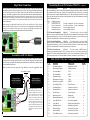
G2 Decoder - Absolute Maximum Ratings
Maximum Input Battery Voltage . . . . . . . . . . . . . . 28 Volts DC
Minimum Input Battery Voltage. . . . . . . . . . . . . . . 10 Volts DC
Maximum Motor Output Current - Pulse . . . . . . . Internally Limited ~ 18A peak
Maximum Continuous Motor Output Current . . . ~ 8 Amps at 25°C @15V
Maximum DCC Auxiliary Output Current . . . . . . 3 Amps
Maximum Headlamp Output Current . . . . . . . . . . 1 Amp
Maximum FnA, FnB Output Current . . . . . . . . . . 1 Amp
3