1
University Program Design Laboratory Package User Guide
UP 1 Education Board
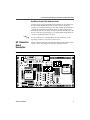
The UP 1 Education Board is a stand-alone experiment board based on
two of Altera’s leading device families: MAX® 7000 and FLEX® 10K. Its
simple design, when used with the MAX+PLUS II software, provides a
superior platform for learning digital logic design using high-level
development tools and PLDs.
The UP 1 Education Board was designed to meet the needs of the educator
and the design laboratory environment. The UP 1 Education Board
supports both product-term based and look-up table (LUT)-based
architectures and includes two PLDs. The EPM7128S device can be
programmed in-system with the ByteBlaster download cable. The
EPF10K20 device can be configured in-system with either the ByteBlaster
download cable or an EPC1 configuration device (not included).
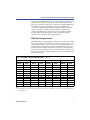
EPM7128S Device
The EPM7128S device, a mid-density member of the high-density, highperformance MAX 7000S family, is based on EEPROM elements. The
EPM7128S device comes in a socket-mounted 84-pin PLCC package and
has 128 macrocells. Each macrocell has a programmable-AND/fixed-OR
array as well as a configurable register with independently
programmable clock, clock enable, clear, and preset functions. With a
capacity of 2,500 gates and a simple architecture, the EPM7128S device is
ideal for introductory designs as well as larger combinatorial and
sequential logic functions.
f
For more information on MAX 7000 devices, go to the MAX 7000
Programmable Logic Device Family Data Sheet.
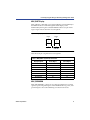
EPF10K20 Device
The EPF10K20 device, a member of Altera’s high-density FLEX 10K
family, is based on reconfigurable SRAM elements. The EPF10K20 device
comes in a 240-pin RQFP package and has 1,152 logic elements (LEs) and
6 embedded array blocks (EABs). Each LE consists of a 4-input LUT, a
programmable flipflop, and dedicated signal paths for carry and cascade
functions. Each EAB provides 2,048 bits of memory, which can be used to
create RAM, ROM, or first-in first-out (FIFO) functions. The EABs can also
be used to implement logic functions, such as multipliers,
microcontrollers, state machines, and digital signal processing (DSP)
functions. With a typical gate count of 20,000, the EPF10K20 device is ideal
for advanced designs, including computer architecture, communications,
and DSP applications.
f
2
For more information on FLEX 10K devices, go to the FLEX 10K Embedded
Programmable Logic Family Data Sheet.
Altera Corporation