1
3. Angel eye rings don’t light up:
• If only one doesn’t light up, it could possible be a faulty
LED bulb, and these are available as spares. Note, however, that like incandescent bulbs, these are consumable
items with a finite life, and they will only be replaced under
warranty if they are faulty when the item is first received
by the customer.
The bulb might also have come loose from its socket and
be floating around inside the headlight, so
remove the grommet underneath the headlight and check.
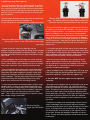
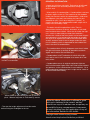
Remove rubber grommets underneath the headlight
unit to gain access to the LED bulbs for the angel
eye rings
• If none of the four angel eye rings light up, the
problem is almost certainly with the wiring, as the chances
of all four bulbs being duds is extremely unlikely. It’s also
possible that all four bulbs have been inserted the wrong
way round.
• Many headlights require the angel eye wiring (and that
for the LED sidelights, if present) to be connected before
fitment, either directly to the sidelight circuit or via a separate switch if desired. Check that this has been done.
• If any connections have been made using “Scotchlock”
type inline splicers, butt connectors or any of the crimp
connectors with coloured plastic insulators, check them
carefully for continuity, as these connectors are notoriously unreliable. The best way to join wiring is by soldering and insulating with heatshrink tubing, or by using
proper crimp connectors with insulating sleeves.
• If the wiring has been connected properly and the rings
still don’t work, it’s likely to have been connected incorrectly, either to the wrong wires or the wrong way round
(unlike incandescent bulbs, LEDs are polarity conscious –
if you connect them the wrong way round, they don’t
work. This usually won’t damage them, however, unless
their voltage rating is exceeded).
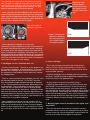
Resistor box for
angel eye LED bulbs
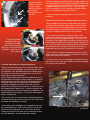
The two different types of LED bulb for angel eye
rings - the rubber grommets have been removed to
show the resistor (arrowed) fitted to the one type.
• There are two different types of replacement LED bulbs
for angel eye rings and LED sidelights – one has resistors
built in, the other doesn’t. It’s important to establish what
type the headlight uses, as they aren’t interchangeable.
Resistor-type bulbs can be identified by checking to see if
any resistor boxes are fitted to the angel eye or sidelight
wiring, or in the case of the angel eye bulbs, by looking at
the LED bulb itself - slide back the rubber grommet to reveal the circuit board underneath and see if a resistor is
fitted or not.
• If a resistor type bulb is fitted where a non-resistor type
is needed, it will light up but emit a dull yellow- rather than
a white light; if a non-resistor type is fitted where a resistor
type is needed, it will blow instantly - and that won’t be
covered by warranty either, for obvious reasons!
• Note that certain headlights have a number of small
capless bulbs fitted at intervals around the ring. These
can be replaced, but usually the headlight must be disassembled to do so. Instructions on how to do this are
normally included with the lights.
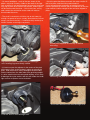
• Some headlights have a non-replaceable LED ring, and
if this fails during the warranty period, the entire unit will
need to be replaced. Check with the supplier first.
4. Car fails MOT because lights are not adjusted
correctly:
• Although most headlights will be reasonably close to the
required setting out of the box, it is imperative that the
beams are checked for correct adjustment once they are
fitted. This doesn’t necessarily require expensive equipment, but it does require that the person adjusting them
knows what they are doing. That means that they need to
know how to measure whether the lights are adjusted
correctly, and which adjusters to turn to achieve the correct result.
• Problems invariably arise when people without the necessary knowledge start turning the adjusters randomly
and end up getting themselves (and the lights) in an awful
mess. If the adjusters are turned too far, the light units
can kink and jam in the housing, or the adjuster can unscrew itself, leaving the headlight impossible to set correctly. Clearly this kind of problem would not be covered
by warranty.