1
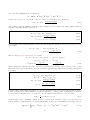
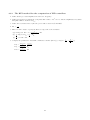
1. F = αI; α > 0
2. F > 0 (positive definite matrix)1
The resulting algorithm has an integral structure. Therefore it has memory (for ε0 (t + 1) = 0, θ̂(t + 1) = θ̂(t)).
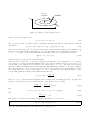
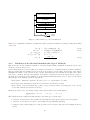
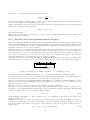
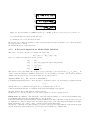
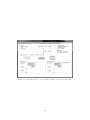
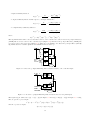
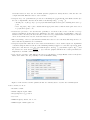
The geometrical interpretation of the PAA of (2.15) is given in Figure 2.3.
The correction is done in the direction of the observation vector (which in this case is the measurement vector)
in the case F = αI, α > 0 or within ±90 deg around this direction when F > 0 (a positive definite matrix may
cause a rotation of a vector for less than 90 deg).
φ(t)
θ (t+1)
θ (t+1)
Fφ(t)ε (t+1) ; F = αI
Fφ(t)ε (t+1) ; F > 0
θ(t)
Figure 2.3: Geometrical interpretation of the gradient adaptation algorithm
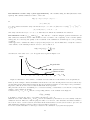
The parameter adaptation algorithm given in (2.15) presents instability risks if a large adaptation gain (respectively a large α) is used. This can be understood by referring to Figure 2.2. If the adaptation gain is large near
the optimum, one can move away from this minimum instead of getting closer.
The following analysis will allow to establish necessary conditions upon the adaptation gain in order to avoid
instability.
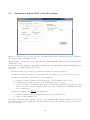
Consider the parameter error defined as:
θ̃(t) = θ̂(t) − θ
(2.16)
From Eqs. 2.1 and 2.4 it results:
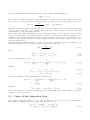
0 (t + 1) = y(t + 1) − ŷ 0 (t + 1) = θT φ(t) − θ̂T (t)φ(t) = −φT (t)θ̃(t)
(2.17)
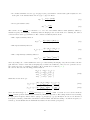
Subtracting θ in the two terms of (2.15) and using (2.17) one gets:
θ̃(t + 1)
=
θ̃(t) − F (t)φ(t)φT (t)θ̃(t) = [I − F φ(t)φT (t)]θ̃(t)
= A(t)θ̃(t)
(2.18)
(2.18) corresponds to a time-varying dynamical system. A necessary stability condition (but not sufficient) is
that the eigen values of A(t) be inside the unit circle at each instant t. This leads to the following condition for
the choice of the adaptation gain as F = αI:
α<
2.1.1
1
φT (t)φ(t)
(2.19)
Improved Gradient Algorithm
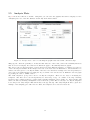
In order to assure the stability of the PAA for any value of the adaptation gain α (or of the eigenvalues of the
gain matrix F ) the same gradient approach is used but a different criterion is considered:
min J(t + 1) = [(t + 1)]2
(2.20)
θ̂(t+1)
1 A symmetric square matrix F is termed positive definite if xT F x > 0 for all x 6= 0, x ∈ <n . In addition: (i) all the terms of
the main diagonal are positive, (ii) the determinants of all the principals minors are positive.
9