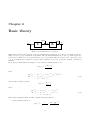
1
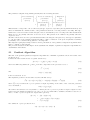
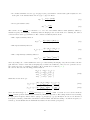
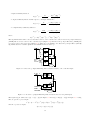
• T contains dominant closed-loop poles given by the polynomial PD and its static gain is adjusted so the
static gain of the transfer function from y ∗ (t) to y(t) is 1. Hence:
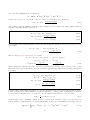
T (z −1 ) =
PD (z −1 )PF (1)
B(1)
(4.5)
P (1)
B(1)
(4.6)
• T is a gain with the value:
T (z −1 ) =
−1
)
m (z
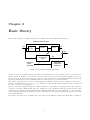
The reference model B
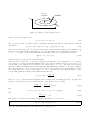
Am (z −1 ) is considered to be a second order transfer function with dynamics defined by
natural frequency and damping. Sensitivity function shaping is the chosen method for assuring the desired
controller and closed-loop performances. The considered sensitivity functions are:
• The output sensitivity function:
Syp (z −1 ) =
A(z −1 )S0 (z −1 )HS (z −1 )
P (z −1 )
(4.7)
A(z −1 )R0 (z −1 )HR (z −1 )
P (z −1 )
(4.8)
B(z −1 )R0 (z −1 )HR (z −1 )
P (z −1 )
(4.9)
• The input sensitivity function:
Sup (z −1 ) = −
• The complementary sensitivity function:
Syb (z −1 ) = −
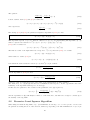
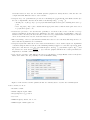
where Syp is shaped to obtain a sufficient closed-loop robust stability, the shaping of Sup allows to limit controller
gain and hence actuator effort and Syb shaping help to limit noise sensitivity of the closed loop and it serves to
fix a desired closed-loop tracking performance. More details can be found in [5, 1, 7].
We can now introduce the following parameterization:
0
(z −1 )γR (z −1 )
HR (z −1 ) = HR
−1
0
HS (z ) = HS (z −1 )γS (z −1 )
PF (z −1 ) = PF0 (z −1 )δR (z −1 )
PF (z −1 ) = PF00 (z −1 )δS (z −1 )
(4.10)
With these notations we get:
−1
−1
0
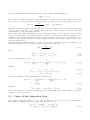
−1 −1 Syp (z −1 ) = A(z )S0 (z )HS (z ) γS (z ) δS (z −1 ) PD PF00 (z −1 )
−1
−1
0
−1 −1 Sup (z −1 ) = A(z )R0 (z )HR (z ) γR (z ) δR (z −1 ) PD PF0 (z −1 )
−1
−1
(4.11)
(4.12)
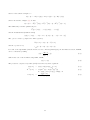
(z )
(z )
−1
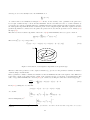
where the filters Fyp (z −1 ) = γδSS (z
) = γδRR(z
−1 ) and Fup (z
−1 ) consist of several second order notch filters
( 2zeros
band-stop
filters
with
limited
attenuation)
simultaneously
tuned. The tuning means in fact searching
2poles
−1 −1 for appropriate frequency characteristics of Fyp (z ) and Fup (z ) . Specifically in our case, we are interested
in frequency band-stop with limited attenuation characteristics and thus the tuning concerns the frequency of
band-stop, its bandwidth and the maximum attenuation in the band-stop frequency.
42