1
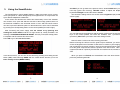
“lazy” behavior. On the contrary, if the aggressiveness is set to 6 (HIGH), even a
displacement as small as 7 – 6 = 1 pixel is big enough to trigger correction, which
implies a very “reactive” behavior.
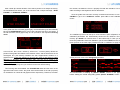
During autoguiding, the trend of the X and Y graphs should always be staying as
smooth as possible. It is advisable to start off with default values for
aggressiveness and guiding speed; then both parameters can be fine tuned to
achieve the best possible sync between your SmartGuider and your telescope.
If you notice any significant oscillations about the zero position of one or both
graphs (overcorrection), the guiding speed should be decreased with the mount
keypad until the oscillation becomes less important (ideally, almost negligible).
Anyway, it must be noted that a little oscillation about the zero position is
acceptable since both graphs depict the offset between two consecutive
exposures with a 2X scale. So, two pixels on the tracking graph are actually
equivalent to one single pixel on the detector. If the oscillation continues even
with the guiding speed at its lowest possible value, the aggressiveness has to be
decreased.
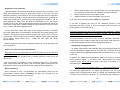
In case the profile of one or both graphs keeps steadily above or below the zero
value (undercorrection), the guiding speed has to be slowly increased until the
graph profile goes back to hovering around the zero position. If no improvement
is seen even with the guiding speed at its highest value, the aggressiveness must
be increased.
Should the graphs still be showing a small, jerky oscillation in spite of the above
precautions, please make sure your equipment is properly balanced in both axes.
It must be stressed that a perfect balance of all the weights, the quality and
solidity of all the mechanical supports and adapters is of paramount importance
in getting round stars and well-tracked exposures! Sometimes, trailing due to
differential flexure can ruin your pictures even with apparently smooth tracking.
5. Technical Specifications
CAMERA
Sensor............................................................................Mono 1/3" Aptina MT9V032
Sensor resolution.........................................................752x480, 6-μm square pixels
Exposure time range............................................................Auto, 0.001 - 2 seconds
Housing................................................................Aluminium, with polycarbonate lid
Nosepiece........................................Standard 1.25-inch (31.8mm) with filter thread
Connectors...............................................................................................8-pin RJ45
Size and weight..................................................D=65mm, H=50mm, Weight: 110g
CONTROL PADDLE
Case………............................................ABS with side non-slip polyurethane inserts
Keypad................................................Three membrane keys with back-illumination
Display.......................................2.5-inch red graphical LCD, 128x64 pixel resolution
Connectors..................................................8 pin RJ45, 12V DC jack, 6 pin RJ12 pin
Size and weight..................................................LxHxD: 55x96x28mm, Weight: 220g
Power requirements…….................................................................8-14V DC,110mA
FEATURES
- Automatic guide star search
- Real-time monitoring of guide star position and focus
- Automatic axis calibration with permanent storage of parameters
- Adjustable display backlight and buzzer volume.
- Adjustable dual-axis aggressiveness
- High-precision 2X sub-pixel autoguiding
GUIDE STAR BRIGHTNESS
60-mm guide scope,2-sec exposure.......................................................approx. 7.5
80-mm guide scope, 2-sec exposure......................................................approx. 8.0
100-mm guide scope, 2-sec exposure....................................................approx. 8.5
FIELD WIDTH AND IMAGE SCALE
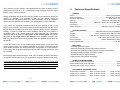
Scope with F = 300mm...........FOV: 51.7x33.0 arcmin............scale: 4.13 arcsec/px
Scope with F = 500mm...........FOV: 31.0x19.8 arcmin............scale: 2.48 arcsec/px
Scope with F = 800mm….......FOV: 19.4x12.4 arcmin….........scale: 1.55 arcsec/px
11
12