1
Page 23 of 24
7.2.3
XML
The ESS file standard differentiates between the maximum (assigned) and the minimum (approved with schedule) capacity. Within
intraday capacity allocation there is no distinction between minimum and maximum capacity; values for the minimum series are set to
those of the maximum series.
7.2.3.1
Product
The field Product in the Time series header is defined as 8716867000016.
7.2.3.2
Area and Party Codes
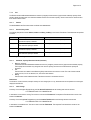
The Capacity Request file contains InArea, OutArea and InParty, OutParty in one Auction Time Series. These elements are specified
as follows:
Element
Field description
Content
InArea
TSO area Code
to which the capacity is directed
According to reference data (10Y…)
OutArea
TSO area Code
from which the capacity is directed
According to reference data (10Y…)
InParty
BG party Code
to which the capacity is directed
According to reference data (10X…)
OutParty
BG party Code
from which the capacity is directed
According to reference data (10X…)
Note: InParty and OutParty have the same content.
7.2.3.3
•
•
•
Schedules, Capacity Allocation Periods (Contracts)
Maximum, minimum:
The ESS file standard differentiates between the maximum (assigned) and the minimum (approved with schedule) capacity.
The Capacity Service however only recognizes one value for capacity; the maximum and the minimum capacity are
equivalent.
Sort:
The time series are created for each Balancing Group with maximum and minimum values. The order of the time series
values are: max, min for one direction, min, max for the other direction.
Netting:
The time series contain netted trade data. Therefore the values for one direction are zero.
Restrictions:
The file has to consist of 96 rows, except for the days of clock change (see 7.2.3.4), otherwise it will not be imported and a message is
displayed in the BG GUI.
7.2.3.4
Clock Change
At the day of clock change to Daylight Saving, the field AuctionTimeInterval has the following start time and end time
YYYY-MM-DDT23:00Z/ YYYY-MM-DDT22:00Z
to indicate the one hour that is missing. The same is true for the field TimeInterval. The respective Time Series Area consists of 92
instead of 96 Intervals.
At the day of clock change from Daylight Saving, the field AuctionTimeInterval has the following start time and end time
YYYY-MM-DDT22:00Z/ YYYY-MM-DDT23:00Z
to indicate the one additional hour. The same is true for the field TimeInterval. The respective Time Series Area consists of 100
instead of 96 Intervals.