1
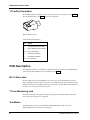
5 T1 Daughter Card
T1’s higher equipment and leased line costs are more than offset by its inherent advantages: reduced
phone bills (payback in months); increased control of the network; improved reliability; quick, cheap,
change implementation; vastly increased speed; and improved voice quality due to the nature of digital vs.
analog lines.
The North American T1 speed of 1.544 M bps is derived from 24 channels at 64K bps each, plus an
overhead of 8K bps for synchronization. The CEPT E1 speed of 2.048M bps is derived from 30 channels at
64K bps each, plus 8K bps for synchronization. T1 transmissions are most economic when voice
(telephone analog signals) and data (computer digital signals) are combined. But to be transmitted
effectively, the normally incompatible voice and data must be “mixed” for compatibility. When digitizing
the analog voice signal, there is a question of the number of bits that can be transmitted economically, and
how to best represent the “smooth variation” in loudness. “Best” typically implies maximum voice quality,
but there can also be tradeoffs for cost, circuit availability, bandwidth, and reliability. The current worldwide standard for digital voice is PCM (Pulse Coded Modulation). A “codec” (coder-decoder) selects the
value closest to the true analog signal, minimizing the distortion, and making the voice transmission
acceptable to the human ear. Technologies like aliasing (voice signal filtering) and non-linear sampling are
used to overcome problems in performing PCM voice compression. The method of non-linear sampling
used in North America and Japan is called mu-law. (A-law is used in other parts of the world.) Similar
technology is used at the sending and receiving ends (i.e., analog-to-digital conversion at one end, and
then digital-to-analog conversion at the other end).
The frequencies around 1000 Hz convey most of the information in a person’s voice. Several methods of
non-linear sampling are available, including Pulse Code Modulation (PCM), Differential PCM (DPCM),
Adaptive DPCM (ADPCM), CVSD, VQC, and HCV. Each has its own associated data transfer rate, cost, and
quality factors.
Historically, vendors used several forms of ADPCM. Now, the T1 data stream from a private T1 network
must:
• represent 8-bit data words of PCM,
• present 24 channels in order from channel 1 to channel 24,
• use a form of robbed-bit signaling, and
• insert the proper framing bit sequence every 193rd bit (i.e., between channel 24 of a frame and channel
1 of the next frame within a superframe).
T1 Frame Formats
Framing is the way T1 equipment formats bits on the T1 line for encoding digital voice. Selecting the
method of framing is a major T1 network design issue. There are five options for T1 frame formatting:
• A D4 Frame carries 24 time slots containing an 8 bit digital “word”, (representing the loudness of a
voice signal) plus a framing bit to mark the start of the sequence.
• A D4 Super Frame contains 12 D4 frames. An F bit separates the frames from each other; the F bit has a
fixed pattern format to identify the start of the frame and the start of the superframe.
• ANSI Extended Super Frame uses 24 frames. The F bit series becomes 24 bits long, identifying every
sixth frame for robbed-bit signaling. The added bits allow support of newer telco features.
• ITU-T G.704 section 2.1.3.1
• ITU-T G.704 section 2.1.3.2
CommPlete Communications Server
43