1
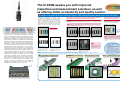
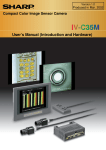
The IV-C35M assists you with improved
inspection and measurement precision, as well
as offering better productivity and quality control.
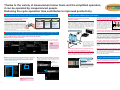
A variety of color filters and a color extraction function clearly distinguish subtle differences in tone and density.
Conventional monochrome cameras cannot
distinguish subtle differences in hue and contrast,
even if they are equipped with custom filters. In
addition to filtering the three primary colors (red,
green, and blue), the IV-C35M can make accurate
images of objects using brightness and other
optional filters, in order to inspect and measure their
qualities. It also has a color extraction function.
Color filter functions for the three primary colors (RGB) and
brightness and 5 optional filters allow easy evaluation.
Color extraction function that can
evaluate a variety of colors.
Select the color components and brightness of an area you want to evaluate, and
display just the specified component. Then convert it to a 256 gray scale or
binary image.
Specify a color to extract from the original image.
The controller eliminates all areas of the image
except those that have the specified color. Then, it
converts what is left into a binary image.
The color filter can be set to display the specified color brightly after gray scale image
NOTE processing. This is effective in evaluating subtle differences in color, or for finding flaws or
dirt that have similar colors or tones.
Original color image
Color extraction
For example, you can
extract just the blue area
of the letter "E" in the
image on left.
Improvements in productivity and quality are critical
issues in production. Of course, these issues are equally
important to inspection and measurement processes.
Sharp has contributed new solutions for inspection and
measurement processes by developing low-priced, highperformance image sensor cameras that leave the others
behind. Now, aiming for even greater improvements in
productivity, we have developed the IV-C35M compact
color image sensor camera. It can inspect and measure
workpieces with minute differences in hue and contrast
that would have been impossible to evaluate using
conventional monochrome cameras. While keeping the
highly sophisticated specifications of earlier models, such
as a unique partial image capture function, this camera is
equipped with a variety of color filters and advanced
measurement programs. Operability has been greatly
improved with features such as interactive, descriptionbased parameter settings that can be used by anyone,
and an easy to read color screen. We would like you to
consider our IV-C35M compact color image sensor
camera if you want to make greater improvements in
productivity and quality control. It can be used for
inspections and measurements in many ways.
R (red) filter
G (green) filter
B (blue) filter
Displays red areas more brightly.
Displays green areas more
brightly.
Displays
brightly.
blue
This color extraction function not only works with
hue and saturation, but also with brightness.
areas
more
NOTE Therefore, achromatic objects that cannot be
processed using a color filter can still be extracted.
* The controller can extract up to 8 colors in one object type. By
specifying multiple object types, it can be used to evaluate even
more colors.
NOTE
Conventional monochrome processing
Conventional gray image
processing
If the hue or color saturation is
very similar between adjacent
areas, the images cannot be
evaluated.
The density of this image can
be measured. However, the
hue and color saturation cannot
be evaluated.
Other applications
The optional filter is effective if
the RGB filters are not used to
show areas as brighter.
Brightness filter Optional filter
Displays areas that are within the
specified brightness range (within the
specified upper and lower limits)
more brightly.
Specify the optimum color filter
parameters to use, based on
the original image conditions.
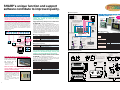
●Can be used to make the following inspections and measurements (using the color extraction function)
Check for lit LEDs in mobile phones
Check whether or not the LEDs in a mobile phone are lit
properly. (Also effective in inspecting the color indicators
on an LCD display.)
Check for incorrect wire harness
arrangement
Detect whether a wire harness is wired as called
for in the specifications.
- Inspect letters with different colors or
background colors.
- Distinguish filled and empty containers
when both the material and the container
have similar colors.
- Detect missing pills in a card of pills.
- Check for the presence of an adhesive
agent when there is only a small
difference between the color density of
the base material and the agent.
Sorting inspection of parts
Inspect by evaluating the color of caps
Sort parts with almost no difference and which
therefore cannot be identified by their shape.
Sort caps and prevent contamination of different
types of material by checking the color of each cap.
For example, apply marks
with different color for each
part type. Then detect the
marks and sort different
types of parts.
IV-C35M
controller
Provide good or NG judgments and detect
incorrect positions of objects using area
measurement and object counting by binary
conversion.
1
A wire harness inspection looks at the
arrangement of the wires by checking for the
specified wire colors using color evaluation and
color position measurement.
Determine whether a color mark matches the
reference color using color evaluation and area
measurement by binary conversion.
Evaluate whether the cap color matches the
reference color.
2