1
3. SOFTWARE INSTALLATION & OVERVIEW
Dynamic C is an integrated development system for writing
embedded software. It runs on an IBM-compatible PC and is
designed for use with Z-World controllers and other controllers
based on the Rabbit microprocessor. Chapter 3 walks you
through the sample programs associated with the RCM3200.
3.1 An Overview of Dynamic C
Dynamic C has been in use worldwide since 1989. It is specially designed for programming embedded systems, and features quick compile and interactive debugging in the real
environment. A complete reference guide to Dynamic C is contained in the Dynamic C
User’s Manual.
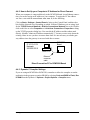
You have a choice of doing your software development in the flash memory or in the data
SRAM included on the RCM3200. The flash memory and SRAM options are selected via
the “BIOS Memory Setting” from the Options > Project Options > Compiler menu.
The advantage of working in RAM is to save wear on the flash memory, which is limited
to about 100,000 write cycles. The disadvantage is that the code and data might not both
fit in RAM.
NOTE: An application can be compiled directly to the battery-backed data SRAM, but
should be run from the program execution SRAM after the programming cable is disconnected. Your final code must always be stored in flash memory for reliable operation.
For RCM3200 modules running at 44.2 MHz, which have a fast program execution
SRAM that is not battery-backed, you should select Code and BIOS in Flash, Run in
RAM from the Dynamic C Options > Project Options > Compiler menu to store the
code in flash and copy it to the fast program execution SRAM at run-time to take
advantage of the faster clock speed. This option optimizes the performance of
RCM3200 modules running at 44.2 MHz.
NOTE: Do not depend on the flash memory sector size or type. Due to the volatility of
the flash memory market, the RCM3000 and Dynamic C were designed to accommodate flash devices with various sector sizes.
Developing software with Dynamic C is simple. Users can write, compile, and test C and
assembly code without leaving the Dynamic C development environment. Debugging
occurs while the application runs on the target. Alternatively, users can compile a program
to an image file for later loading. Dynamic C runs on PCs under Windows 95, 98, 2000,
NT, Me, and XP. Programs can be downloaded at baud rates of up to 460,800 bps after the
program compiles.
Getting Started
17