1
Safety Information
Follow all safety codes. Wear safety glasses and
work gloves. Use a quenching cloth for brazing
operations. Have a fire extinguisher available. Follow
all warnings and cautions in these instructions and
attached to the unit. Consult applicable local building
codes and National Electrical Codes (NEC) for special
requirements.
Recognize safety information. When you see a
safety symbol on the unit or in these instructions, be
alert to the potential for personal injury. Understand
the meanings of the words DANGER, WARNING,
and CAUTION. DANGER identifies the most serious
hazards that will result in death or severe personal
injury; WARNING means the hazards can result in
death or severe personal injury; CAUTION identifies
unsafe practices that can result in personal injury or
product and property damage.
Improper installation, adjustment, service,
maintenance, or use can cause explosion, fire,
electrical shock, or other conditions which may result
in personal injury or property damage. This product
must be installed only by personnel with the training,
experience, skills, and applicable licensing that makes
him/her “a qualified professional HVACR installer.”
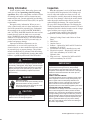
WARNING
The installer must determine and follow all applicable
codes and regulations. This equipment presents hazards
of electricity, rotating parts, sharp edges, heat and weight.
Failure to read and follow these instructions can result in
property damage, severe personal injury or death. This
equipment must be installed by experienced, trained
personnel only.
DANGER
Hazardous Voltage!
Disconnect all electric power including remote
disconnects before servicing. Failure to
disconnect power before servicing can cause
severe personal injury or death.
CAUTION
Use copper conductors only. Unit terminals are not
designed to accept other types of conductors.
Failure to do so can damage equipment.
Inspection
When the equipment is received all items should
be carefully checked against the bill of lading to be
sure all crates and cartons have been received. All
units should be carefully inspected for damage when
received. If any damage is noticed, the carrier should
make the proper notation on the delivery receipt
acknowledging the damage. The carrier should also
fill out a carrier Inspection Report. The McQuay Inc.
Traffic Department should then be contacted. The unit
nameplate should be checked to make sure the voltage
agrees with the power supply available.
A complete unit consists of the following
components, ordered and shipped separately.
1.
2.
3.
4. 5.
6.
7.
Heating/Cooling Chassis and Cabinet or Front Panel.
Wall Sleeve.
Outdoor Louver.
Subbase – Optional for 208V and 230V units but mandatory for all 265V.
Fixed heater with factory installed power cord.
Electrical receptacle – Required for 208V and 230V units, mandatory for all 265V and Hydronic units.
Plug cord cover – Optional for 208V and 230V units but mandatory for all 265V.
IMPORTANT
This product was carefully packed and thoroughly
inspected before leaving the factory. Responsibility
for its safe delivery was assumed by the carrier upon
acceptance of the shipment. Claims for loss or damage
sustained in transit must therefore be made upon the
carrier as follows:
VISIBLE LOSS OR DAMAGE
Any external evidence of loss or damage must be noted
on the freight bill or carrier’s receipt, and signed by the
carrier’s agent. Failure to adequately describe such
external evidence of loss or damage may result in the
carrier’s refusal to honor a damage claim. The form
required to file such a claim will be supplied by the carrier.
CONCEALED LOSS OR DAMAGE
Concealed loss or damage means loss or damage which
does not become apparent until the product has been
unpacked. The contents may be damaged in transit due
to rough handling even though the carton may not show
external damages. When the damage is discovered upon
unpacking, make a written request for inspection by the
carrier’s agent within fifteen (15) days of the delivery
date. File a claim with the carrier since such damage is
the carrier’s responsibility.
IM 934 Applied PTAC / Page of 44