1
Power Products
Applications Information
Power Products Terms (Continued)
Phase angle: specifies the time
domain phase relationship between
two sine waves. The unit of phase
angle is the degree, with one cycle
corresponding to 360 degrees
of phase.
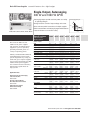
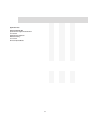
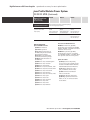
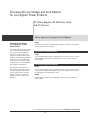
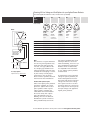
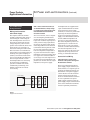
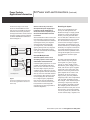
100
Impedence Ohms
10
1
0.1
0.01
0.001
100
10 1 10 2 10 3 10 4
Frequency - Hz
10 5 10 6
10 7
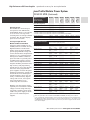
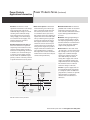
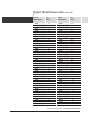
Typical output impedence of a constant voltage power supply
Output impedance: at any frequency of
load change, ∆Eout/∆Iout. Strictly
speaking, the definition applies only
for a sinusoidal load disturbance,
unless the measurement is made
at zero frequency (DC). The output
impedance of an ideal constant
voltage power supply would be zero
at all frequencies, while the output
impedance for an ideal constant
current power supply would be
infinite at all frequencies.
Overcurrent protection: protection of
the power supply, electronic load
and/or connected equipment
against excessive output current.
Overvoltage protection: protection
of the power supply, electronic
load and/or connected equipment
against excessive output voltage.
Overvoltage protection is usually
by means of a crowbar protection
circuit, which rapidly places a low
resistance shunt across the supply’s
output terminals to reduce output
voltage to a low value if a predetermined voltage is exceeded. A supply equipped with an overvoltage
crowbar must also be protected by
a means for limiting or interrupting
the output current.
Peak-to-peak noise: is the range
between maximum and minimum
noise level. Sometimes called noise
“spikes.” Peak-to-peak noise is
typically low in energy and does
not show up in a RMS measurement, 20-20 Mhz.
Programming speed: the maximum
time required for the programmed
output voltage or current to change
from a specified initial value (usually
zero or maximum output) to a value
within a specified tolerance band
of a specified newly programmed
value (for most models 99.9% or 0.1%
of maximum output, respectively)
following the onset of a step change
in an analog programming signal,
or the gating of a digital signal.
Readback: the ability of a power
supply or electronic load to mea sure its actual output voltage and/or current, and provide the reading to a computer.
Remote sensing: remote sensing, or
remote error sensing, is a means by
which a power supply or electronic
load monitors the stabilized voltage
directly at the load or source respectively, using extra sensing leads. The
resulting circuit action compensates
for voltage drops up to a specified
limit in the load leads.
Resolution: for a bench supply, the
smallest change in output voltage or
current that can be obtained using
the front panel controls. For a system supply or electronic load, the
smallest change that can be obtained
using either the front panel controls,
or a computer.
Reverse voltage protection: protection
of the power supply or electronic
load against reverse voltage applied
at the outputor input terminals.
More detailed specifications at www.agilent.com/find/power
139