1
a size about the same as the compact entry
level radios from other manufacturers, this
radio includes many features found in the
largest and most expensive radios on today’s
market. Its performance is comparable or
superior in most respects as well. On the
other hand, there just aren’t as many knobs
and switches on the front of this radio as its
larger brethren. Elecraft uses each button for
at least two functions. The one shown on the
button happens with a quick tap. A secondary, often related, function, shown below the
button, is enabled with a longer, 1⁄2 second
or more, push. It doesn’t take long to get the
fingers programmed. The buttons and knobs
are organized into groups by function, and I
had no problem getting to know them.
While size and weight are of particular
importance to those who want to take the
radio with them as they travel, or who operate
in close quarters, front panel space is limited.
Controls are somewhat smaller and closer
together than on some larger radios, although
I found them all accessible and easy to use.
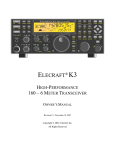
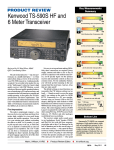
Perhaps the display provides the biggest difference. The K3 includes a two-line
monochrome LCD that shows all critical operating information. It doesn’t offer the bells
and whistles of the “big boys,” particularly
a spectrum analyzer — perhaps expected at
the upper end of the K3 price range. An IF
OUTPUT jack is provided (as part of the optional KXV3 transverter module) so that an
external spectrum scope can be supported. At
least one manufacturer provides a very competent one that works with a PC and provides
“point-and-drag,” frequency selection.2
Thus, with an added spectrum scope for
home station operation, the combination of
displays can rival top-end transceivers. At
the same time the basic radio remains ready
for the campground or emergency operations
center. For some, this will be the best of
all worlds. Those who don’t travel or don’t
need the compact footprint may wish it were
somewhat larger.
How’s it Play?
In a word, this is one fine radio. I was so
impressed with its published performance
that I will happily confess to having purchased a 100 W kit version for myself. I don’t
think that makes me biased, since I’ve had
much more cockpit time to get to know the
K3, for better or worse, than most equipment
I’ve reviewed over the years. The ARRL Lab
measurements were taken with a current
production radio. We’ve also spent quite a
bit of time using an early production K3/100
that’s been upgraded as accessories and new
firmware have become available.
2LP-PAN
software defined IQ direct conversion
panadapter for the K3. Available as a kit or
fully assembled from Larry Phipps, N8LP, at
www.telepostinc.com.
From January 2009 QST © ARRL
Table 1
Elecraft K3, serial number 1915
Manufacturer’s Specifications
Measured in the ARRL Lab
Frequency coverage: Receive, 0.5-30,
48-54 MHz; transmit, 1.8-2, 3.5-4, 5.33-5.40,
7-7.3, 10.1-10.15, 14-14.35,18.068-18.168,
21-21.45, 24.89-24.99, 28-29.7, 50-54 MHz.
Receive and transmit, as specified.*
Power requirement: 11-15 V dc; transmit,
17-22 A; receive, 0.9 A (without subreceiver).
As specified. Operation confirmed
at 11 V.
Modes of operation: SSB, CW, AM, FM, FSK,
AFSK, PSK, data.
As specified.
Receiver
Receiver Dynamic Testing
SSB/CW sensitivity, 500 Hz bandwidth:
Noise Floor (MDS), 400 Hz bandwidth:**
–136 dBm (typical), preamp on.
Preamp Off Preamp On
1.0 MHz
–111 dBm
–119 dBm
3.5 MHz
–131 dBm
–138 dBm
14 MHz
–130 dBm
–138 dBm
50 MHz
–130 dBm
–136 dBm
Noise figure: Not specified.
14 MHz, preamp off/on: 12/9 dB.
AM sensitivity, 6 kHz bandwidth, 10 dB S/N:
10 dB (S+N)/N, 1 kHz, 30% modulation:
Not specified.
Preamp Off Preamp On
1.0 MHz
15.6 µV
10.6 µV
3.8 MHz
1.6 µV
0.9 µV
50 MHz
2.1 µV
1.6 µV
FM sensitivity, 12 dB SINAD: Not specified.
For 12 dB SINAD:
Preamp Off
29 MHz
0.55 µV
52 MHz
0.62 µV
Preamp On
0.40 µV
0.44 µV
Blocking gain compression: 140 dB typical
Gain compression, 400 Hz bandwidth:**
at 2, 5 and 20 kHz spacing with 400 Hz,
20 kHz Offset 5/2 kHz offset
8 pole roofing filter.
Preamp Off/OnPreamp Off
3.5 MHz
142/137 dB 140/139 dB
14 MHz
142/138 dB 140/140 dB
50 MHz
140/138 dB 128/124 dB
Reciprocal Mixing (500 Hz BW): Not specified.
20/5/2 kHz offset: –112/–100/–86 dBc.
ARRL Lab Two-Tone IMD Testing**
Band/Preamp Spacing
Input Level
3.5 MHz/Off
20 kHz
–23 dBm
–14 dBm
0 dBm
Measured
Measured
IMD Level
IMD DR
–131 dBm
108 dB
–97 dBm
–60 dBm
Calculated
IP3
+31 dBm
+28 dBm
+30 dBm
14 MHz/Off
20 kHz
–24 dBm
–13 dBm
0 dBm
–130 dBm
106 dB
–97 dBm
–60 dBm
+29 dBm
+29 dBm
+30 dBm
14 MHz/On
20 kHz
–35 dBm
–21 dBm
–138 dBm
103 dB
–97 dBm
+17 dBm
+17 dBm
14 MHz/Off
5 kHz
–25 dBm
–14 dBm
0 dBm
–130 dBm
105 dB
–97 dBm
–59 dBm
+28 dBm
+29 dBm
+30 dBm
14 MHz/Off
2 kHz
–27 dBm
–14 dBm
0 dBm
–130 dBm
103 dB
–97 dBm
–59 dBm
+25 dBm
+28 dBm
+30 dBm
50 MHz/Off
20 kHz
–26 dBm
–11 dBm
–131 dBm
105 dB
–97 dBm
+27 dBm
+32 dBm
Second-order intercept: Not specified.
It’s Got Features
The K3 does almost anything you can
imagine, and some things we didn’t imagine
until we saw them! The latter category most
notably includes the way it can operate popular digital modes in a stand-alone fashion.
It decodes RTTY, PSK31 and even CW
on the display, as do a few other high-end
transceivers — but the K3 also can send in
these modes by internal translation from
Preamp off/on: +75/+75 dBm.**
Morse using keyer paddles. Remarkable
indeed!
While it seems like a gimmick, it can be
helpful — as when you see a rare station
running RTTY posted on the DX cluster and
you’re operating portable or don’t have your
station set up for RTTY. The short display
space might be a limit for a rag chew, but
not for a DX contact. I’ve actually made such
contacts. The K3 Utility Program, required