1
Chapter 4. Implementation
40
4.1.3. USB-serial-bridge Replacement
The USB-serial-bridge FT232RL was initially selected because it can easily be integrated into the
circuit via serial interface and relieves the firmware due to its own processing unit and prefabricated
functions. However, it is highly priced and can only operate as a virtual serial device. To reduce the
costs and increase the flexibility of the USB, the ATXMega192A3 was replaced by a newer version
with USB connectivity. That is the ATXMega192A3U for the WifiCtrl and the ATXMegaA4U for
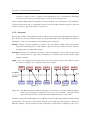
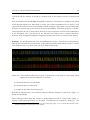
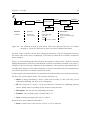
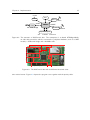
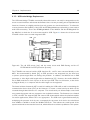
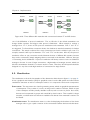
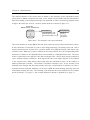
the MiniCtrl, in which the U in the name stands for USB. Figure 4.5 shows the old circuit with
FT232RL and the new one with integrated USB.
USB
+5V
DD+
FT232RL
Rx
Tx
GND
GND
+5V
USB
MCU
D+
4 ESD
3
MCU
EMI
GND
1
2
D-
GND
PRTR5V0U2X
Figure 4.5.: The old USB circuit (top) and the newer circuit with EMI filtering and the IC
PRTR5V0U2X for ESD protection (bottom).
The FT232RL was removed and the USB data lines D+ and D- were connected directly to the
MCU. As recommended by Atmel [30], an ESD protection was integrated into the data lines
to prevent power surges which can damage the platform. In addition, the WifiCtrl has an EMI
protection to allow high cable length without disturbances [31]. However, the smaller MiniCtrl
has no EMI circuit due to lack of space on the two layer PCB. This is no limitation, as the device
is plugged directly to a computer and the cable length can be neglected.
The Atmel software framework ASF is used for handling the USB traffic as well as initializing the
communication device class (CDC) in the firmware. It creates a virtual serial port which can be
accessed through Atmel drivers on a computer. The virtual serial port allows simple control with
every terminal program and easy integration into individual software. The firmware is not limited
to CDC; the ASF also supports HID and custom USB classes which makes the platform suitable
for custom applications, where CDC is not appropriate. The USB clock is generated internally by
multiplying the processor clock by two, consequently the processor clock had to be scaled down
from 32 Mhz to 24 Mhz to match the 48 Mhz USB clock. This reduces the overall speed of the
system and therefore increases the base load, which affects the real-time capabilities of the system.