1
CHAPTER 1
DRAWMER DC2476 DIGITAL
MASTERING PROCESSOR
INTRODUCTION
The Drawmer DC2476 is an extremely sophisticated, all-digital stereo
mastering processor designed for use in demanding recording and
broadcast applications. Both analogue (balanced XLR) and digital (AES/
EBU and S/PDIF) I/O is provided as standard. The audio converters are
24-bit and the digital output can be either 16, 18, 20 or 24-bit at sample
rates of up to 96kHz. Noise shaped dithering is included and Word Clock
input and output is available. A new feature is Output Trim which sets the
maximum level that output can reach, even in bypass, making the DC2476
easier to use in a broadcast environment.
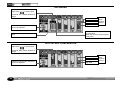
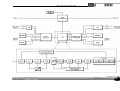
Designed to be extremely easy and intuitive to use, the Drawmer DC2476
comprises a stage of dynamic equalisation, also incorporating full-band
compression (the DQ stage), followed by a five-band equaliser modelled on
the response of classic analogue filters. The signal is then split into three
user definable bands where it is routed via a three-band expander, a threeband compressor, a three-band limiter and a three-band modelled tube
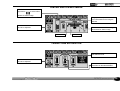
saturation stage. The three bands are then recombined before being fed to
the output stage via a fader system that can be used to generate precise
fade-ins and fade-outs of user definable length. The output stage itself offers
a number of dither options.
This makes setting up far more intuitive when adjusting the individual bands
of a multi-band compressor and also avoids the necessity to juggle the
make-up gain control settings.
Why 96kHz?
Digital processing has until now been confined to 48kHz sampling frequency.
In order to achieve the required bandwidth for professional audio, a very
severe low pass filter at 23kHz is required to separate analogue signal
frequencies from the clock frequency otherwise unpleasant aliasing will occur.
This requires the use of a FIR digital filter which is part of the A/D and D/A
converters. Unfortunately these filters cause what is known as >time smear=,
where short transients are smeared over a longer time period giving loss of
HF detail. At 96kHz sample frequency, the low pass filter is less severe and
at twice the frequency, so time smear is considerably reduced.
A second important consideration is the increased audio bandwidth up to
40kHz. This allows harmonics which extend above human hearing to be
generated and preserved. These harmonics, although not audible
themselves, make a contribution to the sound quality.
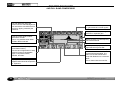
Finally, the user interface has been designed to make the Drawmer DC2476
as simple to operate as possible. In fact, once you’ve got used to using the
cursor buttons, the Adjust knob and the Adjust knob push switch to move
around the various screens and their parameters, operation is almost entirely
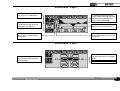
intuitive. Custom graphics are used wherever possible to monitor the
processor function and its adjustments while front panel LED bargraph meters
constantly monitor the input and output signal levels, limiter activity, plus the
amount of gain reduction being applied in each of the three frequency bands.
Although a wide range of manual control is provided, an automated gain
management system is used in addition to 'Programme Adaptive' time
constant management in the compressor and expander stages. The
automatic gain management monitors the signal level at critical points
throughout the signal chain and automatically reduces levels in situations
when overloads would otherwise occur. This makes the Drawmer DC2476
impossible to overload. Another key feature is the use of a 'Bootstrap'
compressor. Conventional compressors reduce the level of audio peaks, which
means make-up gain has to be applied to restore the same peak level. The
Drawmer DC2476 works the other way around by instead increasing the level
of quieter signals and leaving the peak levels at their original values.
5