1
MORE ON THE MIX/FADE KNOB
Traditionally, mastering engineers used a mix function when cross-fades between two analog tape
machines were used to segue between songs. Now that is much easier done in the workstation. But
in recent years, with the availability of convolution reverb programs and sizable libraries of impulse
responses (IRs) on the internet, some mastering engineers are finding that a touch of convolution reverb
helps gel dryer mixes. The effect should not be like “reverb” in the traditional sense but more like a
naturally complex flavor. Not surprisingly, the most likely IR candidates are fast decaying real rooms
somewhat on the “dry” side. The bad news is that it can be unpredictable, which IR works best with
each session or even each song, and auditioning IRs can be time-consuming and tedious. In any event,
it is a dangerous technique and one to be used sparingly and subtly, unless the client requests to put reverb on a whole mix. But there are plenty of free “colors” to add to your palette if you have the inclination to experiment on your own time.
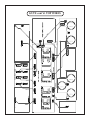
There are other possible sources you may want to try. For example, both the sum and difference
signals appear on the back panel XLRs and you may find that you can do some really dramatic equalization or compression on either of those and mix it lightly back into the stereo mix, similarly to what
was described in the “Sum-Difference Musings” section earlier. You would need a special XLR “Y”
cable to do this right. This cable would start with a female XLR, with two balanced lines coming out
of it to two male XLRs. Very important note: One male XLR gets wired conventionally and the other
male XLR needs to be wired reverse phase and that XLR should get boldly marked “RIGHT”. There is
a diagram of this cable on page ???.
Another possibility is introducing a processor that might ordinarily be considered too colored or
distorted for mastering but if mixed in lightly (as opposed to running the full signal through it), can be
brought in under the main signal. This technique may tend to vary dynamically depending on the nature
and depth of the distortion. For example, if it is set up to be a conventional clipping effect, during quiet
passages, there may be no clipping, during moderate levels where there is some clipping, the mixed-in
effect might seem significant. However, with even hotter passages, the clipping is preventing that effect
from gaining more output level, while the dry signal has had no such restraint, so the relative mix will
lean more toward dry. Pre-limiting that color-box can prevent the distortion from becoming too nasty.
Yet another combination that can be excellently mixed in is the limiter-EQ, where you have the
EQ set for drastic high boost or drastic “smiley face” boosted low & highs & dipped mids. What happens is that as the signal level drops, with this low threshold limiter-EQ, the proportion of “wet” signal
becomes relatively stronger. In the first case, it would give more highs and air at low levels without becoming harsh and biting once the song gets loud. The second case acts a bit like an automatic FletcherMunson EQ where both highs and lows seem bigger at lower levels (opposite of what our ears normally
do, so it sort of “compensates”) and this happens without the usual drawbacks of just boosting lows and
highs. It is probably best to have the limiter set up to be digging in at relatively lower levels, which is
quite the opposite of typical limiter settings. Note, that normal transients are passed by the “dry” part of
the chain. Also, these kinds of tricks can bring a new motivation for keeping gear that may have been
collecting dust, because it doesn’t require the ultra-high performance that you need for the primary
chain.