1
[4]
CCNP SWITCH 642-813 Quick Reference
CHAPTER 1
by Denise Donohue
Campus Network Design
Chapter 1
Campus Network Design
An enterprise campus generally refers to a network in a specific geographic location. It can be within one building or
span multiple buildings near each other. A campus network also includes the Ethernet LAN portions of a network outside
the data center. Large enterprises have multiple campuses connected by a WAN. Using models to describe the network
architecture divides the campus into several internetworking functional areas, thus simplifying design, implementation,
and troubleshooting.
The Hierarchical Design Model
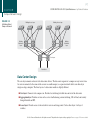
Cisco has used the three-level Hierarchical Design Model for years. The hierarchical design model divides a network into
three layers:
n
Access: Provides end-user access to the network. In the LAN, local devices such as phones and computers access
the local network. In the WAN, remote users or sites access the corporate network.
n
High availability via hardware such as redundant power supplies and redundant supervisor engines. Software
redundancy via access to redundant default gateways using a first hop redundancy protocol (FHRP).
n
Converged network support by providing access to IP phones, computers, and wireless access points. Provides
QoS and multicast support.
n
Security through switching tools such as Dynamic ARP Inspection, DHCP snooping, BPDU Guard, port-security,
and IP source guard. Controls network access.
© 2010 Pearson Education, Inc. All rights reserved. This publication is protected by copyright. Please see page 112 for more details.