1
Chapter 20 - CAChe Computational Applications
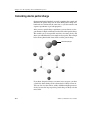
energy of a solvent by the method of image charges. It assumes that
the medium is a conductor. For water, this is a very good
approximation. The method is generalized by constructing a
conducting polygonal surface based on the van der Waal’s atom radii
and an effective solvent radius.
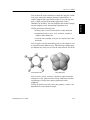
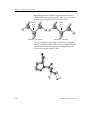
A good example of the method is modeling the solvent effect of
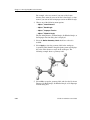
water on the geometry of alanine. In the gas phase, MOPAC predicts
that neutral alanine (H2N-CH2-CH2-COOH) is more stable than the
zwitterionic form (+H3N-CH2-CH2-COO-). When COSMO is used
to model the solvent effects, the zwitterion is correctly predicted to
be more stable.
Because COSMO includes solvent effects for energy gradients as
well as energy, it is applicable to all types of MOPAC calculations.
However, because COSMO requires a considerable amount of
computation, it should not be used unless solvent effects are
important.
Because of extra memory usage, calculations that use COSMO
cannot handle as many atoms as those that do not use it. The practical
limit depends upon computer speed and memory but for most
computers the practical limit is approximately 200 atoms.
Large molecules
MOPAC contains a patented method called MOZYME that alters
the way in which the electronic structure is calculated. As a result,
calculations on large chemical systems require on a small fraction of
the memory needed for a conventional calculation and run very
much faster.
MOZYME can be used for simple geometric calculations, such as
geometry optimization and transition state location, and for the
calculation of polarizability.
There are limitations when this option is used.
•
•
20-20
Only closed shell RHF calculations are allowed. Thus large
molecule calculations are limited to chemical samples in their
ground state. Radicals electronic excited states cannot be run.
The results are not so precise. For calculations that need high
precision MOZYME should not be used.
BioMedCAChe User Guide