1
EMBL CMCI ImageJ Basic Course
1.5 Analysis of Time Series
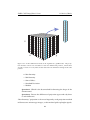
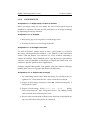
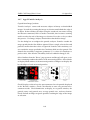
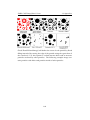
In the following, I will list some of the standard methods for the automatic
segmentation of objects, which is the first part of the automated tracking.
Detected objects are then linked from a frame to the other.
CentroidMethod
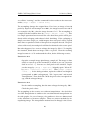
The centroid is the average of all pixel coordinates inside the segmented
object and is the most commonly used feature for representing the object
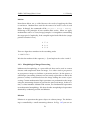
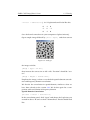
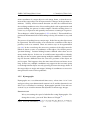
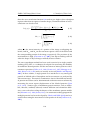
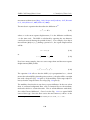
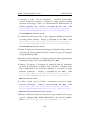
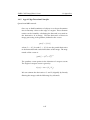
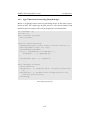
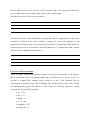
position. The centroid coordinate pc ( x, y) can be calculated as
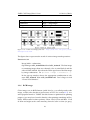
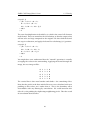
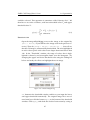
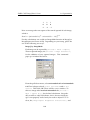
pc ( x, y) = (
∑ xi ∑ yi
,
)| x,y∈R
n x ny
(1.12)
where R is the region surrounded by the contour, and n is the total number
of pixels within that region. In other words, all x coordinates of the pixels
inside the object are added and averaged. The same happens for all y coordinates. The derived averages for x and y coordinates represent the centroid coordinates of the object. The position of the object can be measured
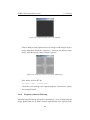
for every frame of the sequence manually. In ImageJ, centroid calculation
is available in the "Particle Analysis" function.
Gaussian Fitting Method
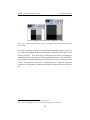
For spherical signals such as fluorescence beads or fluorescently labeled
sub-resolution particle, the signal intensity distribution can be fitted to a
standard two-dimensional Gaussian curve (Anderson et al., 1992; Schütz
et al., 1997; Tardin et al., 2003):
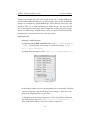
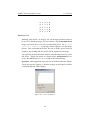
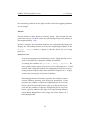
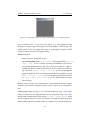
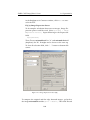
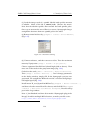
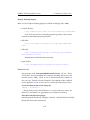
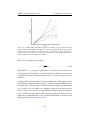
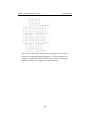
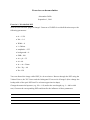
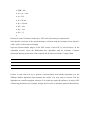
I ( x, y) = z0 + zn exp{−
( x − Xn )2 + (y − Yn )2
}
Wn2
(1.13)
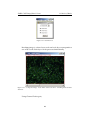
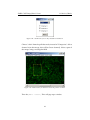
where I ( x, y) is the intensity distribution of an image, z0 is the background
intensity, and zn is the height of the peak. Wn is the width of the curve that
peaks at ( Xn , Yn ). This peak position is the signal position. Although this
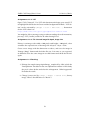
fitting method is restricted to spherical or oval objects, it yields the most
precise measurements even with a very low signal-to-noise ratio (Cheezum
124