1
NXP LPC21/23xx Quick Start
Memory Accelerator Module (MAM)
The MAM is an interface designed to speed up flash execution by providing the next ARM instruction to
prevent core fetch stalls. It eliminates the need to wait for most flash memory fetches. However, in the
event of a cache miss, the delay is still only limited by the number of MAM fetch cycles required. The
LPC21xx flash memory is split into dual banks, accessed independently. Each bank has its own 128-bit
prefetch and branch trail buffers. In 32-bit ARM mode, these buffers can provide 4 instructions per fetch.
The LPC23xx has a single bank of flash memory and three 128-bit buffers (prefetch, branch trail, and
data).
The MAM has three modes of operation. In mode 0, the MAM is off, and every memory request initiates
a flash fetch. Mode 1 partially enables the MAM. A fetch is initiated whenever there is no data in the
latches or the memory request is non-sequential. Otherwise, the latched data is used. The MAM is fully
enabled in mode 2, and a fetch executes only if the latches lack data. Mode 2 provides the best
performance but offers the least predictability.
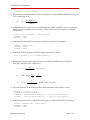
1) To set up the MAM, clear the MAM Control register (MAMCR).
MAMCR = 0;
2) Update the MAM Timing Control register (MAMTIM) with the number of flash wait cycles required
for the specified clock speed. (Note: consult the user manual, “MAM usage notes” to determine the
recommended number of fetch cycles at a given Fosc.)
MAMTIM = options->TIMING;
3) Finally, the MAM Control register is updated with the required mode.
MAMCR = options->MODE;
Vectored Interrupt Controller (VIC)
Internally, the ARM core only has two interrupt inputs: Interrupt Request (IRQ) and Fast Interrupt
Request (FIQ). FIQs have higher priority than IRQs. Assigning only one FIQ results in the fastest
interrupt response. The VIC facilitates the programmable assignment and reassignment of multiple
interrupt sources and their priority levels.
LPC21xx Family
1) For each required interrupt, set its type, priority, and return address.
static const vic_t EXAMPLE_Settings =
{
.ISR = VIC_EXAMPLE,
.FIQ = 0,
.PRIORITY = 0,
.ADDR = (uint32_t)example
};
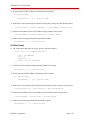
2) Clear the selected interrupt with the Interrupt Enable Clear register.
VICIntEnClr |= (1 << options->ISR);
Digi-Key Corporation
Page 4 of 7