1
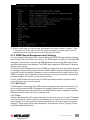
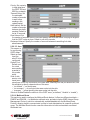
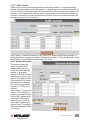
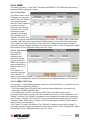
“Modify.” Changes will be updated in the display window. To save any changes and make them
effective immediately, click “Submit.” Click “Refresh” to refresh the settings.
NOTE: The system only supports PIM-DM version 2.
NOTE: Before enabling, IP Multicast Route Mode on the IGMP screen must be set to “PIM-DM.”
2.2.6.5 VRRP
The Virtual Router Redundancy Protocol (VRRP) is designed to eliminate the weak point inherent
in the static default routed environment. VRRP specifies an election protocol that dynamically
assigns responsibility for a virtual router to one of the VRRP routers on a LAN. The VRRP
router controlling the IP address(es) associated with a virtual router is called the “master,” and
forwards packets sent to these IP addresses. The election process provides dynamic fail-over
in the forwarding responsibility, should the master become unavailable. Any of the virtual router’s
IP addresses on a LAN can then be used as the default first-hop router by end-hosts. The
advantage gained from using VRRP is a higher-availability default path without requiring any
configuration of dynamic routing or router discovery protocols on every end-host.
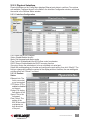
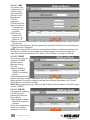
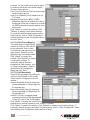
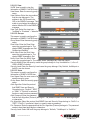
Virtual ID: One virtual router ID can be used as the default gateway for one or several VLANs.
The range is 1 – 255.
Virtual IP: This can be any IP address that belongs to the VLAN to be managed. In general, it can be the same as the interface IP address, acting as the master router.
Priority: This is the virtual router priority, used by this VRRP router in selecting the master for
this virtual router. The range is 1 – 254 (default is 100), with higher values meaning higher
priority. The value of 255 (decimal) is reserved for the router that owns the IP addresses associated with the virtual router. Zero is reserved for the master router to indicate that it is
releasing responsibility for the virtual router. The range 1 – 254 (decimal) is available for VRRP
routers backing up the virtual router.
Advertisement Interval: This is the time interval between advertisements (in seconds). Default is
1 second.
Preempt Mode: Controls whether a higher-priority backup router preempts a lower-priority master. Values are True to allow preemption and False to prohibit preemption. Default is True.
2.2.7 Bridge
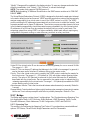
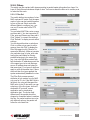
The Bridge page group contains Layer 2 configurations. The 12 subsections are Spanning Tree,
Link Aggregation Static, LACP, Mirroring, Static Multicast, IGMP Snooping, Traffic Control,
Dynamic Addresses, Static Addresses, VLAN Configuration, GVRP and QoS/CoS.
2.2.7.1 Spanning Tree
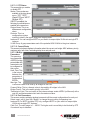
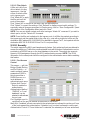
This section is for configuring the Spanning Tree Protocol. Four subsections present additional
options: STP Status, Current Roots, Bridge Parameters and Port Parameters.
web management
21