1
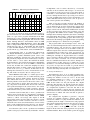
1. main{
2. ...
3. if( input < 10){
4.
setMotor1();
5. }
6. else{
/*disable ISR2*/
7.
SREG = val;
8.
setMotor2();
9. }
10. }
11. ISR2(){
12. ...
13. }
14. ISR1(
non_interruptible){
15. ...
16. i2cSend(ADDR, Length,
Data)
17. }
18. i2cSend(...){
19.
for(i = 0; i < 10;
i++)
20.
i2cSendData[i] = *
data++;
21. ...
22. check(data)
23. ...
24. }
Fig. 2: Example of WCSU Over-estimation
overcome this limitation, most existing analyses determine for
each program point which interrupts are enabled or disabled.
Imprecision can occur because of several reasons. First,
without running the program being assessed, it is difficult
to statically track the changes to the interrupt status, which
is commonly done by modifying the status register (e.g.,
SREG) using variables instead of constants. Most tools include
a pre-defined set of operations (e.g., cli and sei) where
interrupts are commonly disabled/enabled. Interrupts that fall
outside of this set must be annotated by the user. Second,
interrupts are highly platform dependent so static analysis is
not applicable in the case that the interrupt status is dynamically changed by other software components or by underlying
systems at arbitrary system execution points. Third, with the
complexity of these programs and the variety of interrupt
sources, it is difficult for static analysis to reason about the
possible interrupt interleavings for interrupt-driven embedded
systems that typically use the priority preemptive scheduling
policy [25]. This can become even harder or infeasible for
static analysis if the priority is adjusted at runtime. Fourth, the
value analysis used to determine stack usage of interrupt-driven
code suffers when indirect function calls, memory accesses,
stack pointer modifications, and data dependencies between
the main program and ISRs occur. Finally, modern embedded
systems (e.g., automative systems) tend to be integrated with
libraries and encrypted object code from different vendors.
Figure 2 shows a simplified snippet of code from our
experiments, on which we ran three static analysis tools [5],
[9], [32]. All three report the WCSU path
Pw =<main->setMotor2->
->ISR2->ISR1->i2cSend->check>
This path overestimates the WCSU because line 7 disables
interrupt 2, so ISR2 cannot be called inside setMotor2.
While static analysis may track interrupt bits written with
constant values, it is obfuscated when the interrupt register is
written with a variable. This problem may be addressed by
by more precise data-flow analysis, but it is unclear whether
such analysis is applicable to interrupt-driven programs. In
addition, the interrupt disabling/enabling operations may not
be visible when calling encrypted third-party libraries. Such
information can be observed only at runtime.
C. Weighted Multi-Objective Genetic Algorithms
S IM S TACK formulates the test case generation problem as a
multi-objective optimization problem using a weighted fitness
approach. In a genetic algorithm, a population of individuals
are evolved iteratively over a series of generations using a
set of genetic operators (crossover, mutation, selection). The
fitness function determines which individuals are closest to the
stated objective and this is used during selection and crossover
to evolve the next generation. In a weighted GA, each objective
in the fitness function is given a coefficient which is the
weight for its fitness value [26]. The weights can be tuned to
drive the application more towards one objective or another.
Since a weighted GA can only find a single best solution, it
is commonly applied to multi-objective problems where it is
possible to prioritize or order the objectives in a meaningful
way [26] As noted in Section I, the goal of S IM S TACK is
to assess the WCSU produced by static analysis, while also
constructing new test cases that compute different WCSUs
if the paths reported by static analysis cannot be exercised.
As such, we can use two objectives and prioritize them. The
first (higher priority) objective is increasing the stack size.
The second objective is path coverage. Note that weights can
impact both effectiveness and efficiency of WCSU estimation
(described in Section V). The weights can be empirically
chosen to maximize effectiveness.
For path oriented coverage, the state of the art fitness
function comprises two measures: an approach level and a
path distance [35]. When both of the metrics are 0 the desired
test data has been found. The approach level records how many
path sections (edges in the CFG) are missed by a particular
input. Consider the example from Figure 2 and assume the
target is the edge 3-4 for the true branch. If an input takes the
false then the approach level is 1, otherwise it is zero.
III.
S IM S TACK
We now present S IM S TACK. We begin with its architecture
and then described the genetic algorithm in more detail.
A. SimStack Architecture
Figure 3 illustrates the overview of S IM S TACK. It is
implemented on AVRORA, a simulator platform that supports
programmable event monitoring and application profiling [32].
We use the simulator because it allows for control of the
interrupts; it provides system level observability and controllability. The Execution Engine and Execution Profiler are builtin modules. We use the programming interfaces AVRORA
provides to create three additional modules to support testing:
an Interrupt Controller, a Test Case Generator, and an Event
Observer. We re-use the interrupt controller and event-observer
from prior work for this framework [36]. The Static Analyzer
is optional. We can plug a variety of existing tools into this
part of the framework. S IM S TACK is configurable so that
we can, for example, disable static analysis (due to platform
restrictions) and use only the GA portion of the test case
generation instead. We can also disable the GA and use random
test case generation.
The input to S IM S TACK is an initial (possibly empty) test
suite and a set of (optional) paths generated by the static
analyzer module (if applicable). For each static path, the GA
targets that path to evolve the test suite. When there are no
static paths, the GA evolves using only information from the
test suite in its fitness function. As test cases are generated,
they are executed to determine fitness (described later in this