1
platforms and can serve multiple aspects of research and
education in sensor networks. The DataTruck platform is built
around a S3C2440A ARM920T RISC microprocessor from
Samsung Semiconductor and a CC2431 radio with a 250kbps
raw data rate from Chipcon. The choice of the S3C2440A
microcontroller provides a wealth of peripherals and flexible
modes of operation. The Chipcon radio and its use with an
IEEE 802.15.4 compliant MAC protocol, make our node
interoperable with other sensor nodes available in the
community such as Telos and Micaz.
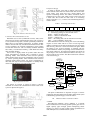
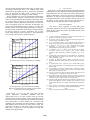
Fig. 2. The hardware design graph of main processing unit
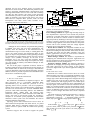
Fig. 1. In this hybrid network, static nodes send data to rendezvous points
at first, and mobile node only needs to visit the rendezvous points to save the
data delay transmission for the moving trajectory of mobile node is shortened.
Although the above schemes can perform data gathering
in MWSN well, there still exist some disadvantages. For
example, when the DataTruck in the intersection area of
communication range of several nodes, it should gather data
one by one which increases the transmission delay. In this
paper, we improve the performance of data gathering in WSNs
by considering two critical factors: mobility and space-division
multiple access (SDMA) technique. To the best of our
knowledge, this is the first work that introduces SDMA
technique to mobile sink node design and explores the utility
of a joint design of mobility and SDMA technique in data
gathering schemes.
The rest of this paper is organized as follows. Section II
introduces hardware design of DataTruck and the compare of
other mobile nodes. In section III, we design a dual-antennas
system on DataTruck using smart antenna technology based on
SDMA. Section IV presents experiment and simulation results
and section V concludes the paper.
II. HARDWARE DESIGN
A. The core circuit board
The architecture of DataTruck is depicted in Figure 2. The
main processing unit is a S3C2440A ARM920T RISC
microcontroller [13]. We found this processor to be an
appealing choice since it provides a rich set of peripherals,
multiple power options and a suitable memory configuration.
The CPU core of S3C2440A is a 16/32-bit ARM920T RISC
processor which offers outstanding features. The ARM920T
implements MMU, AMBA BUS, and Harvard cache
architecture with separate 16KB instruction and 16KB data
caches, each with an 8-word line length. By providing a
complete set of common system peripherals, the S3C2440A
minimizes overall system costs and eliminates the need to
configure additional components.
Operating System and Communication Protocol Stack: To
make DataTruck interoperable with other devices, we ported
Chipcons IEEE 802.15.4 compliant medium access control
protocol which we operate inside the ARM Linux operating
system.
DataTruck Support API: In order to support the special
features of DataTruck we implemented a specialized protocol
that consists of the following modules:
Power Manager Module To support long term deep sleep we
have implemented a supervisor circuit outside the processor
operated by a real-time clock (RTC) with two interrupts. With
this circuit, the node has software control to transition into a
deep-sleep mode by disabling its main power supply regulator.
The RTC is directly powered by the batteries and not by the
on-board voltage regulator. This allows the RTC to keep track
of time with its own oscillator, when the voltage regulator
powering the rest of the board is disabled.
Device Drivers Module This component includes the low
level interfaces to all the devices and the I/O peripherals on the
DataTruck including the radio, the Real Time Clock, the ADC,
the UART, the timers and the DMA controller. Using this
module, applications can easily use all the devices connected
to the various I/O interfaces of the node.
Radio Manager Module This module is responsible for
configuring the communication subsystem. Applications can
call this component to change the transmission power level of
the radio and/or its security configuration.
Frequency Manager Module The frequency manager is
responsible for changing the operating clock frequency of the
node while preserving the correct timing of the operating
system, the Zigbee MAC layer and the application running on
the node.
B. The motor drive circuit
DataTruck uses L298P as motor circuit to drive its 4 linear
motion actuators. The L298 is an integrated monolithic circuit
in a 15-lead Multiwatt and PowerSO20 packages. It is a high
voltage, high current dual full-bridge driver designed to accept
standard TTL logic levels and drive inductive loads such as
relays, solenoids, DC and stepping motors. Two enable inputs
are provided to enable or disable the device independently of
the input signals. The emitters of the lower transistors of each
bridge are connected together and the corresponding external
terminal can be used for the connection of an external sensing
resistor. An additional supply input is provided so that the logic
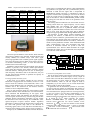
works at a lower voltage. The motor drive circuit is depicted
in Fig.3.
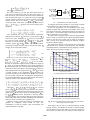
The speed of motor is calculated using formula (1), which is
adjusted by controlling the PWM duty cycle through
programming. Suppose
is maximum rotation speed of
.
motor, duty cycle is , the average speed of motor is
(1)
In this formula,
is a duty-cycle.
is a value of
cycle of a timer, which is preset by the processor and is the
time of high level in the cycle which is set in the program to
.
satisfy
2090