1
Chapter 2:
2.1
Theory
Introduction
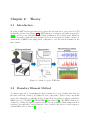
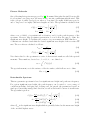
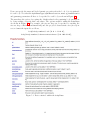
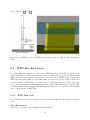
Modeling a WEC involves the interaction between the incident waves, device motion, PTO
mechanism, and mooring (Figure 2.1). WEC-Sim uses a radiation and diffraction method
[1, 2] to predict power performance and design optimization. The radiation and diffraction
method generally obtains the hydrodynamic forces from a frequency-domain boundary element method (BEM) solver using linear coefficients to solve the system dynamics in the
time domain.
Figure 2.1: Methodology for WEC-Sim
2.2
Boundary Element Method
A common approach to determining the hydrodynamic forces is to presume that they are
the sum of incident, radiated, and diffracted wave components. These forcing components
are modeled using linear coefficients ideally obtained from a frequency-domain potential flow
BEM solver (e.g., WAMIT [3], AWQA-FER [4], and Nemoh [5]). The BEM solutions are
obtained by solving the Laplace equation for the velocity potential, which assumes the flow
is inviscid, incompressible, and irrotational. More details on the theory for the frequencydomain BEM can be found in [3].
6