1
4.6
4.6.24
Expansion Module MAC00-FD4
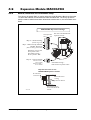
Connecting MAC00-FD4 to the DeviceNet-bus
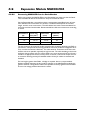
Before you connect the MAC00-FD4 to the DeviceNet-bus make sure that the Baudrate, the Node-ID and the termination is setup to the desired values.
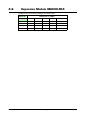
On the DeviceNet bus it is possible to have a transmission speed (Baud-rate) of maximum 500 Kbit/s and a minimum of 125 Kbit/s. The Baud-rate depends on the cable
length, and the wires cross-section. The table below have some recommendations for
networks with less than 64 nodes. Recommended bus cable cross-section are according
to CiA®:
Bus Distance
(m)
Cross-section (mm2)
Terminator
(ohm)
Baud-rate
(Kbit/s)
100
0.34-0.6
150-300
500
250
0.34-0.6
150-300
250
500
0.5-0.6
150-300
125
The bus wires may be routed in parallel, twisted and/or shielded, depending on EMC requirements. The layout of the wirering should be as close as possible to a single line structure, in order to minimize reflections. The cable stubs for connection of the bus node
shall be as short as possible, especially at high bit rates. The cable shielding in the house
shall have a large contact area. For a drop cable a wire cross-section of 0.25 to 0.34 mm²
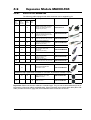
would be an appropriate choice in many cases. In section 4.3.46 of this chapter there is
an overview showing various JVL standard cables. All the JVL cables are twisted and
shielded.
For bus lenghts greater than 500m, a bridge or repeater device is recommended.
Galvanic isolation between the bus nodes is optional. In the MAC00-FD4 modules the
galvanic isolation is integrated to obtain best possible immunity against noise and differences in the voltage potential between the nodes.
228
JVL Industri Elektronik A/S - User Manual - Integrated Servo Motors MAC050 - 3000