1
Project No. 004074
NATURNET-REDIME
D.4.2.1
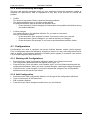
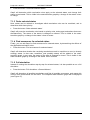
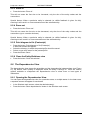
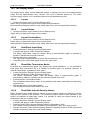
Figure 49. The simulation preferences window.
The simulation preferences specify certain aspects of the reasoning performed by the
simulation engine. Changing these preferences may affect the outcome of the simulation. These
preferences are included because they may be useful in certain situations for advanced
modellers, but they should be used with care.
The following preferences can be turned on or off:
•
Apply closed world assumption in influence resolution (default: off)
Activating this preference implies that influenced quantities (by means of P's or I's) for which
the impact of the influencing quantity can not be determined are assumed to be steady (as if
the influencing quantity had no influence). This should not be confused with quantities that
are not influenced at all; they remain unaffected by this assumption.
•
Apply epsilon ordering (default: on)
The epsilon order rule (De Kleer, 1984) states that changes from a point value (and changes
from equality) happen instantly and therefore precede changes that take at least some small
amount of time, such as changes to a point or equality. When this preference is turned off,
all terminations are treated as being similar from this perspective.
•
Apply quantity space constraints on extreme values (default: off)
This preference determines whether or not the derivative of a quantity is allowed to keep
increasing (or decreasing) in the highest (or lowest) point of the quantity space. When
running a simulation the question is whether a quantity may increase while being in its
highest point. There is no single answer to this issue, because it depends on what the
modeller wanted to represent with the upper limit in the quantity space. Is it a real limit
beyond which the quantity magnitude cannot go? Or is it a virtual limit: the magnitude of the
quantity may become higher beyond this landmark but the values above the landmark are
not of interest? By using this preference the modeller can decide upon a perspective as
appropriate for the model created. When the quantity spaces include real limits, this
preference can be turned on to apply the quantity space constraints on the derivative of
quantities with extreme values.
•
Apply correspondences in ordering (default: on)
Correspondences are crucial for merging possible terminations. Often when quantities (or
specific values) correspond, it means that both quantities will need to change value at the
same time. On very rare occasions a modeller may not want this approach and view all
terminations as independent. This can be realised by turning off this preference. Be aware
however that not using correspondences in ordering easily results in an explosion of
possible transitions. You are therefore advised not to switch this preference off.
87
/ 107