1
Manual V1.4 ENG
Copyright © 2008-2009 Vladimir Afanasiev E-mail: [email protected] WWW: www.digflow.ru
Page 4
sensor with a known ID code that is located in the operational range.
Pressing Button 2 selects the value's order (one of four digits) that can be then modified. The
selected digit appears underlined on the screen. Pressing Button 3 sets the value of this digit, which
ranges from 0-9.
The general procedure for detecting ascending air flow
Air mass with a higher temperature relative to the surrounding air has a lower spec. gravity or
density and therefore ascends. This lies in the principle of the formation of ascending air flows. The Sun
warms up a certain region of the Earth's surface, in the process forming a warm air mass. When this air
mass reaches a certain temperature, affected by the wind, it rises from the Earth's surface ascending in the
wind's directional flow. The sportsman then has to locate the formation and take-off of the ascending air
flow using the graph, or has to locate the already formed air flow in the area where the sensor was
installed.
In order to correctly detect the ascending air flow, the sensor's mast has to be as tall as possible.
Near the ground air has a higher turbulence, which decreases the accuracy of detecting warm and cold air
masses. In addition to this, the closer the sensor is to the ground, the more distant it is from the center of
ascending air flow; the final formation of which happens at a height of several dozen meters from the
ground. Therefore, the sensor's mast height has to be 8-10 meters or higher from the ground.
When setting up the sensor's mast, it is necessary to account for the wind's speed and desired time
period from locating the ascending air flow to launching the model. If the wind is weak, the mast has to
be positioned about 5-10 meters from the model's launching position and against the wind. If the wind is
strong, the mast has to be positioned in a more distant location. Generally, the mast has to be positioned
by practical considerations. The distance from the model's launching position to the mast has to be big
enough to provide time for launching the model. The model has to gain altitude before the ascending
airflow would reach the zone of model's start.
The relation between temperature graphs and weather conditions
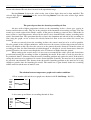
1. Even weather (this and the next graph were obtained with Y Axis Range – 0.64°С):
Tsens
25.00
48.0
Tavg
24.97
∆T
0.03
2. Air warms up and forms an ascending thermal air flow:
Tsens
25.45
Tavg
25.07
∆T
0.38
48.0