1
which ensures that no single cell is written to more than others. This process also requires data to be copied from one
block to another, which further increases the necessity for free blocks to be available. To ensure free blocks are available,
Garbage Collection algorithms consolidate good data and erase blocks of invalid data. This process too, however, requires
free blocks to use for temporary storage while the invalid blocks are cleared.
OP helps with garbage collection, wear-leveling and bad block management by effectively increasing the size of the
controller’s “work bench,” thus giving it extra free space to use while it consolidates and moves data or retires worn
out cells.
All of the above tasks are the reason WAF exists – writing data to an SSD is not a simple one-to-one operation. There are
complex processes taking place behind the scenes at all times.
Why Use OP?
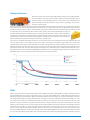
OP has a direct effect on SSD performance under sustained workloads and as the drive is filled with data. Guaranteeing
free space to accomplish the NAND management tasks discussed above (Garbage Collection, Wear-Leveling, Bad
Block Management) means the SSD does not have to waste time preparing space on demand, a process that requires
additional time as data is copied, erased, and recopied. An added benefit is that OP makes all of the SSD maintenance
procedures more efficient, reducing the WAF by ensuring there’s room to work. Consider this scenario: You are a chef
with very limited counter space (say one arm’s length across and half and arm’s length deep). Preparing a 5-course meal
in such a limited area would mean you have to waste a lot of time moving things around or putting them away to make
room for other tasks. Now, imagine you quadruple your work space. You can leave everything you need at hand, reduce
repeating steps (like getting the salt from the pantry and putting it back away), and increase your working speed. The
same goes for SSDs. Give them more room to work, and they can do it more quickly and efficiently, reducing WAF and
increasing performance at the same time.
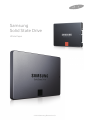
OP and the 840 Series SSD
As NAND process technology advances, the chips themselves become increasingly smaller. As they shrink, the chips
also become less reliable at holding data. There are a number of ways to mitigate this problem, including using ErrorCorrecting Code (ECC). As explained above, any time we give the controller more work to do, it requires more room on its
“work bench” to do it efficiently.
The 840 Series represents the first consumer SSD to implement 3-bit/cell MLC (also called TLC) technology. This
technology, as its name suggests, stores 3-bits of data per cell, as opposed to the 2-bits per cell that today’s more
common Multi-Level Cell (MLC) NAND holds. Because, as just mentioned above, the size of the chips themselves is also
shrinking, in effect we are squeezing even more information into a smaller space.
This is nothing a good firmware algorithm can’t handle, however. Samsung’s 3-bit/cell MLC-based SSD 840 Series,
equipped with mandatory OP, will still far outlast the useful life of the hardware it powers.
Closing Thoughts
OP, while already popular among SSD enthusiasts, will continue to become an important safeguard for SSD performance
and endurance as the NAND industry continues to shrink chips to save on cost, increase efficiency, and expand
capacities. Samsung sets a lower value for its mandatory OP on the 840 Series than any other competitor, a feat that is
possible because of its top-tier NAND chips and superior maintenance algorithms. As the NAND industry continues to
evolve, Samsung will continue to be on the cutting edge, and optimizing features like OP is just one of the many ways it
will continue to provide SSD users with the best storage devices on the market.