1
CHAPTER 3
Pulse Sequencing
3.1 Background
Sequencing typically requires construction of a sequence table which defines the order in which waveforms are played
along with control-flow instructions. In existing commercial AWGs, these control-flow instructions are limited to
repeated waveforms (basic looping) and non-conditional goto statements to jump to other sections of the waveform
table. More recently, equipment manufacturers have added rudimentary conditional elements through event triggers to
conditionally jump to an address in the waveform table upon receipt of an external trigger. This capability introduces
branches into the sequence table. Equipment manufacturers have also expanded the memory re-use concept by subsequences which allow for jumping to sections of the waveform table and then returning to the jump point in a manner
similar to a subroutine or function call in a standard programming language.
These recent additions expand the number of sequence flow graphs that can be built with these primitives. However,
they are still limited in several ways. First, previous implementations have not allowed arbitrary combinations of
control-flow constructs. For instance, it may be diserable to have all control-flow instructions be conditional, so that,
for example, subsequence execution could depend on external input. Or it may be desireable to construct recursive
control-flow structures, i.e. nested subsequences should be possible. Second, event triggers are not sufficiently expressive to choose between branches of more than two paths. With wider, multi-bit input interfaces, one can construct
higher-order branches (e.g. with a 2-bit input you could have four choices).
In short, rather than having an instruction set that allows for a limited number of control-flow graphs, we wish to
expand the instruction set of AWGs to allow for fully arbitrary control flow structures.
3.2 Sequencer Design
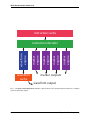
To achieve arbitrary control flow in an AWG, we adopt modern CPU design practice and separate the functions of control flow from instruction execution. An instruction decoder and scheduler broadcasts waveform and marker instructions to independent waveform and marker engines, while using control-flow instructions to decide which instruction
to read next. This asynchronous design allows for efficient representation of common AWG sequences. However, it
also requires reintroducing some sense of synchronization across the indepent waveform and marker engines. This
is achieved in two ways: SYNC instructions and write flags. The SYNC instruction ensures that all execution engines have finished any queued instructions before allowing sequencer execution to continue. The write flag allows
a sequence of waveform and marker instructions to be written to their respective execution engines simultaneously.
A waveform or marker instruction with its write flag low will be queued for its corresponding execution engine, but
instruction delivery is delayed until the decoder receives an instruction with the write flag high.
13