1
SIDSA
Semiconductor Design Solutions
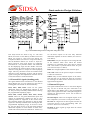
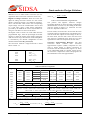
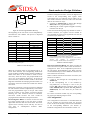
Fig 2.2: Detailed Block Diagram of the Configurable Analog Block (CAB)
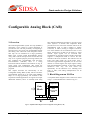
Four major blocks are shown in fig. 2.1: The Gain
Block (see section 3: Gain Block), the Data Conversion
Block (see section 4: Data Conversion Block), the
Comparators Block (see section 5: Comparators Block)
and the Reference Block (see section 6: Reference
Block). However, these three blocks are completely
interrelated in a very flexible manner: The references
for the amplifying stages and the AD/DA converters
are provided by the reference block, while you can set
references using DACs or outputs of some amplifying
stages. This way, the DACs can set the common mode
references of the amplifying sections, and the analog
signals coming thru the amplification channels can set
as well the references of the DAC/ADCs.
2.1 External I/O signals (bonding pads)
The signals marked with crossed boxes in the detailed
block diagram (fig. 2.2) are external I/O pins tied to
bonding pads. All of them are described hereby:
In1P, In1N, In4P, In4N: These are the global
differential inputs for amplification channels #1 and
#4. They are always internally buffered before entering
the programmable amplifying stages.
In2P, In2N, Out2P, Out2N, In3P, In3N, Out3P,
Out3N: These are the global differential inputs and
outputs for amplification channels #2 and #3. Two
operating modes are supported: In the normal mode,
these channels behave like channels #1 and #4 (Input
signals are internally buffered before entering the first
programmable amplfiying stage); in the direct mode,
the user has direct access to the first fully balanced
differential amplifier of each channel. In both cases,
Out2P and Out2N (Out3P and Out3N for channel #3)
Chapter 3. Configurable Analog Block (CAB)
are the direct outputs of the first fully balanced
differential amplifier of the the channel (see section 3:
Gain Block).
Ref8, Ref0: They are the inputs to the voltage divider
of the reference block from which the normal
references are generated from. Note that an internal
16K ±30% resistor is placed between these two pins
(see section 6: Reference Block).
RefX: This is high impedance extra reference input.
O3P, O4P: These are the positive outputs of channels
3 and 4 for external use.
OD1-4: They are the buffered outputs of the DACs.
Note that they can be used even when the converters
are working in an ADC mode to monitor the succesive
approximation algorithm.
2.2 Internal I/O ports
The signals marked with arrows in the block diagram
(fig. 2.2) are in internal I/O ports connected to the
digital macro cells (DMCs), that is, the programmable
logic. These signals have their counterparts mapped as
registers for microprocessor access. All of them are
described hereby:
PLOutComp1-4: These are the digital outputs of the
four comparators (see section 5: Comparators Block).
PLconv1-4: A high level on these signals activates the
conversion process in the corresponding ADC (see
section 4: Data Conversion Block).
PLdone1-4: These signals go high when the related
conversion ends.
3