1
4.1
Principles of biosusceptometry
4.1.1 Magnetic Susceptibility
All materials are influenced by magnetic fields. How the materials respond to applied magnetic
fields determines their magnetic properties. Ferromagnetic materials such as iron act to strongly
concentrate magnetic flux and are greatly attracted to an induced magnetic field. In addition, the
response is highly non-linear and hysteretic. Paramagnetic substances (metals other than iron,
cobalt or nickel, gases like oxygen and some organic materials) are weakly attracted to an
induced magnetic field. Diamagnetic materials (H2O and some organic materials) are very
weakly repelled by an induced field. Finally superconductors are diamagnetic, but strongly
repelled by an induced magnetic field. The response of paramagnetic and diamagnetic materials
are linear and non-hysteretic. Mathematically, we can represent the magnetic interactions by the
following equation:
B=χH
eq. 4.1
where B is the magnetization of the object, H is the applied magnetic field and χ is the object's
magnetic susceptibility.
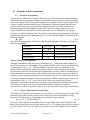
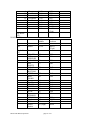
Material
response
χ (SI units)
Ferromagnetic
Paramagnetic
Diamagnetic
Superconductor
1 ~ 100's
10-4
-10-6
-1/4π
Non-linear & hysteretic
Linear & Non-hysteretic
Linear & Non-hysteretic
Linear & Non-hysteretic
Table 4-1 Table of Susceptibilities
Although contaminants in the lung can be ferromagnetic (e.g., inhaled dust from welding), no
known human tissues are ferromagnetic. Iron storage molecules such as ferritin and hemosiderin
are paramagnetic with χ ~ 10-4. This paramagnetic response is directly proportional to the
number of iron atoms present in these iron storage molecules. Thus a magnetic susceptibility
measurement can directly determine the iron concentration. In reality, if there are diamagnetic or
other paramagnetic materials present in the sample being measured, they must be accounted for.
Fortunately, other than iron storage molecules, the human body does not contain other naturally
occurring paramagnetic substances in measurable quantity. While not paramagnetic, body tissue
is diamagnetic with χ ≈ -9·10-6, quite close to that of water. By taking into account the
diamagnetic background contribution of body tissue (and ignoring the insignificant contribution
from molecular oxygen, trace metals and deoxyhemoglobin), magnetic susceptibility
measurements can be used to produce direct in-vivo measurements of hepatic iron concentration.
4.1.2 Theory of Biomagnetic Susceptibility
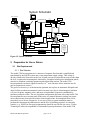
The response of a magnetic susceptometer is given by the size of the magnetic flux change (∆Φ)
produced at the pickup coil due to the presence of the object whose susceptibility is being
measured. The flux change is calculated from the following volume integral:
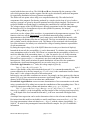
∆Φ = (µo Id)-1 ∫v χ(r) Bf(r).Bd(r) d3r
eq. 4.2
where χ(r) is the magnetic susceptibility of the test object, Bf(r) is the magnetizing field, and
Bd(r) is the reciprocal flux density of the detector coil (i.e., flux density generated by a current of
Id in the detector coil). In our case, Bd(r) is provided by a first-order gradient field coil which is
Model 5700 Biosusceptometer
page 26 of 76