1
PROTOCOL
Communication parameters
Every Nokeval device uses 8N1 bit protocol, i.e. 8 data bits, none parity, and one stop
bit. Baud rates depend on device in concern, see its user manual. Recommended baud
rate is 9600 bits per second.
The control characters presented below are one byte each, and every character (letter
or number or space) in the command takes one byte as well.
Command frame
The actual command is composed of letters and numbers and is human readable. The
commands recognized by a device are specified in its user manual; however some
most common commands are represented in this manual also.
The command frame is obtained by adding some control bytes to the actual command:
ID command
ETX BCC
Start byte ID
The start byte is the only byte in SCL protocol that has the most significant bit set.
This identifies that a completely new command frame is to come. The ID is formed
from the device address (0-123) by setting the most significant bit, or by adding 128
(80h) to the address.
Address 126 (ID byte 126+128=254) is reserved for general call. The purpose of this
is to provide a connection to a device the address of which is not known. When using
this procedure, there should be only one device on the bus. This is supported by
certain products only.
Note: The ID is one byte, not a series of separate numbers (e.g. ‘1’, ‘2’, and ‘8’).
Actual command
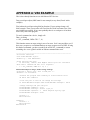
The command is sent as is. The command can be for example ”MEA CH 1 ?”.
End byte ETX
The command is terminated with single byte with value of 3 (03h), this is called ETX.
Do not send Ascii character ‘3’.
Checksum byte BCC
The target device calculates the checksum and compares it to the BCC sent with the
command to see if the command has transfer errors. The BCC is a single byte that is
calculated using XOR operation (bitwise exclusive OR) on every byte in the actual
command and ETX (ID is excluded!).
Some Nokeval devices have an option to disable the BCC, because it may be too
difficult to calculate in some applications.