1
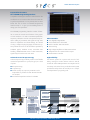
Nanonis SPM Control System The Base Package of the Nanonis Control System provides the full functionality for basic SPM applications. From signal conditioning and AD/DA conversion to real-time signal processing and the graphical user interface, the Nanonis Base Package provides a fundamental framework that can be adapted and extended with a range of add-on modules. All basic processes such as z-control, scan-control, data acquisition, atomic manipulation, lithography and spectroscopy are included, allowing easy control of elementary STM and AFM operations. Fully Digital System All analog signals are converted immediately and internal processing is fully digital. This has become possible only recently with the latest advances in the performance of processors and AD/DA converters. The advantages are: The system is very flexible and scalable. Software adaptations are all that is needed for rapid custom developments. Digital signal links are immune to noise, which is crucial for SPM applications. It has removed the limitation of range and resolution, which was a drawback when linking systems with analog signals was common. 24 Signal Channels The generic analog interface provides 24 live signals: 8 outputs, 8 inputs and 8 internal signals. This allows connection of signals including bias voltage, tunneling current, deflection, x, y, z, external lock-ins etc. The software displays all electronic signals as real world numbers in floating-point representation, with assigned SI units for immediate quantitative results. High Resolution AD/DA Conversion “There is plenty of room at the bottom“, said Richard Feynman when he described his vision of the science that led to nanotechnology. Enormous resolution is required to reveal the smallest features, while maintaining an acceptable sample range. The Nanonis system employs sophisticated digital filtering, oversampling and dithering techniques to provide the highest resolution. The patented hrDAC™ technology turns the 16-bit DA converters into real 22-bit devices which would fill up a full board and cost ten times as much in a traditional approach. There is no need to switch gains and co-ordinates are absolute over the full range. Nanonis is pushing the limits for high resolution scanning. Interactive Scan Control The control system for a scanning probe microscope is like a cockpit and the pilot needs to be supported in all his maneuvers on the flight through the nano-world. The scan control module is interactive and dynamic. It is possible to zoom-in on acquired data, paste scanned data to the background for reference and display different channels in multiple windows. The motion of the tip is visualized in real-time. In summary, this system is designed to be a pleasure to use, in line with our promise: Free to explore and discover. Versatile z-Controller The distance between tip and sample can be controlled by any signal or combination of signals. The quantitative parameters allow the application of control theory models and yield a further understanding of tip-sample interaction. The user-configurable z-controller allows onthe-fly switching between settings such as input signal and feedback parameters. Signal Analysis and Monitoring All signals can be inspected with the FFT spectrum analyzer, signal charts, oscilloscope or signal history. Such fully digital and integrated software instruments are much more efficient in use, less invasive, better in performance and lower in cost than their external counterparts. This is of great value for optimizing the experimental setup, eliminating disturbances and thus improving the quality of the scientific results. Innovation in Surface Spectroscopy and Microscopy Systems